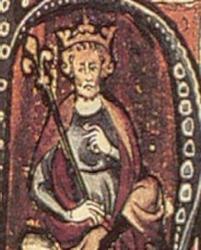
Christian IX
 Denmark
- Early Life and Education
- Marriage and Family
- Accession to the Throne
- Domestic Rule and Reform
- Legacy and Death
Early Life and Education
Christian IX was born on April 8, 1818, in Gottorp Castle, into the Glücksburg branch of the House of Oldenburg. As the fourth son of Duke Friedrich Wilhelm of Schleswig-Holstein-Sonderburg-Glücksburg, he was not a direct heir to the Danish throne. Despite his lineage, Christian grew up in Denmark and attended the Military Academy in Copenhagen.
Marriage and Family
In 1842, Christian married his ambitious cousin, Princess Louise of Hesse-Kassel, in Copenhagen. Their union, later known as the "Father-in-Law of Europe," produced six children. Due to the absence of heirs from King Frederick VII, Christian became the chosen successor to the Danish throne.
Accession to the Throne
Following Frederick VII's death in 1863, Christian ascended to the throne as Christian IX. Denmark faced a succession crisis and territorial disputes with Prussia and Austria, which resulted in territorial losses for Denmark during the Second Schleswig War in 1864.
Domestic Rule and Reform
Christian IX's reign saw both challenges and reforms. Despite supporting an authoritarian Prime Minister, he also oversaw the implementation of Iceland's home rule and constitutional reforms. In 1901, he appointed Johan Henrik Deuntzer as Prime Minister, symbolically embracing democratization in Denmark.
Legacy and Death
Christian IX passed away peacefully at Bernstorff Palace on January 29, 1906. During his reign, Denmark experienced significant social welfare improvements, including the introduction of old-age pensions and unemployment benefits. Today, his descendants include monarchs throughout Europe, solidifying his legacy as the "Father-in-Law of Europe."