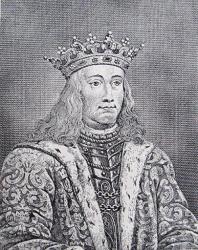
Hans Uhan II
 Denmark
Hans Johann II - King of Denmark, Norway, and Sweden
BiographyHans Johann II, also known as Hans, was born on February 2, 1455, to his parents Christian I and Dorothea of Brandenburg. He was the Duke of Schleswig and Holstein and ruled as the King of Denmark, Norway, and Sweden during his lifetime. Hans was also known by different names in different regions, such as Hans in Danish and Norwegian, and Johan in Swedish and German.
During his reign, Hans aimed to solve three main political challenges: restoring unity, fighting against the Hanseatic League, and strengthening royal authority. He pursued a delicate diplomatic game in the early years of his reign, attempting to weaken the position of the Swedish regent Sten Sture and searching for new political allies. He became the first Danish king to form an alliance with Russia through a treaty signed in 1493. Hans also supported Danish privateers, whose activities undermined the power of the Hanseatic League.
Hans' domestic policy was characterized by economic support for Danish merchants and the appointment of commoners to government positions, despite the dissatisfaction of the nobility. One of his most significant accomplishments was the creation of a regular Danish fleet, which would later play a substantial role in the country's history.
He managed to secure his position as a co-ruler in Schleswig and Holstein alongside his younger brother, Frederick. By undermining the power of Sten Sture in Sweden, Hans persuaded the majority of Swedish nobles to join his side. After a swift military campaign in 1497, Hans was crowned as the King of Sweden. He ruled wisely in Sweden and forgave all his enemies.
In 1500, together with his brother Frederick, Hans assembled an army of German mercenaries and waged war against the peasant republic of Ditmarsh in Northern Germany. However, the Ditmarshers lured the professional soldiers into a trap and opened the dikes protecting the low coastal area from the North Sea. The defeat shook the king's prestige, and by 1501, he was expelled from Sweden. In the following years, Hans continued to fight against the forces of Sten Sture and his successor, Svante Nilsson. During this time, he demonstrated a volatile and cruel nature. The war led to tensions with Danish nobility and the Hanseatic cities, particularly Lübeck. Finally, in 1509, a peace treaty was signed, formally recognizing Hans as the King of Sweden, but the country retained its independence.
In Norway, opposition forces attempted to overthrow Hans in 1507, but Vice-King Prince Christian suppressed the revolt.
In the last years of his reign, Hans continued his struggle against Sweden and Lübeck, which resulted in maintaining the status quo for all parties involved.
In popular memory, Hans is remembered as a ruler who was approachable, jovial, and down-to-earth. His cruelty and political ambitions took a back seat. There are parallels between his actions and those of Louis XI of France and Henry VII of England.