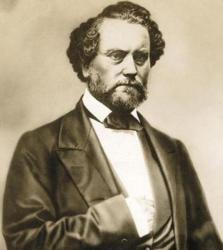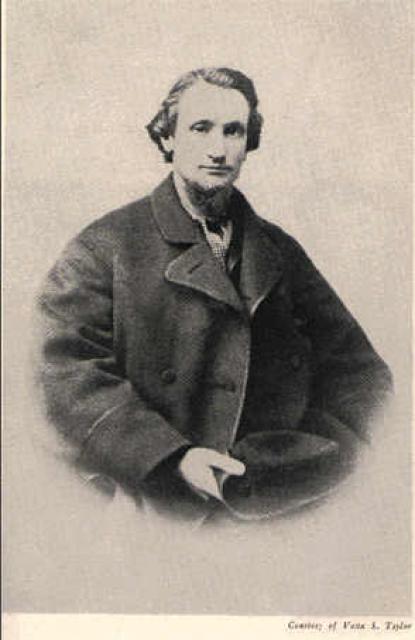
Christopher Miner Spencer
 USA
USABiography of Christopher Miner Spencer
Christopher Miner Spencer, an American inventor, was born on March 6, 1860. Growing up in Connecticut, Christopher, or Kit as he was known in his childhood, did not receive a formal education due to his family's impoverished state. However, he learned everything he could on his own. At the age of 12, he left home to dedicate his life to the production of firearms. His first mentor was Josiah Hollister, a renowned gunsmith and marksman from Kentucky who had previously made weapons for George Washington. Hollister not only taught Christopher the skills of a gunsmith but also instilled in him a passion for hunting, a passion that Christopher carried with him throughout his life.
After completing his apprenticeship, Christopher took a four-year hiatus from gunsmithing, traveling around the country and engaging in various occupations, from monitoring equipment at a silk factory in Manchester, Connecticut to repairing locomotives in New York. However, his love for firearms eventually prevailed, and in 1854, he began working at Samuel Colt's factory in Hartford before moving on to the Robbins & Lawrence Company, which specialized in producing Sharps rifles. Working on Sharps rifles inspired Spencer to think that a nation living on horseback needed a weapon that allowed for rapid firing without the cumbersome process of reloading.
On March 6, 1860, an important day in Christopher Spencer's life, he received a patent for his invention - the Spencer Carbine. The Spencer Carbine was a .52 caliber weapon (although its actual caliber ranged from .54 to .56) equipped with a lever-action breechblock. A significant difference was the magazine housed in the stock. It consisted of a metal tube with another tube inside, fitted with a spiral spring. The magazine could be removed from the stock and loaded with seven rounds before being inserted back and locked with a cover. Prior to firing, the breechblock lever had to be lowered, ejecting the spent casing from the chamber while simultaneously picking up a new cartridge from the magazine. When returned to its original position, the breechblock would send the cartridge into the barrel, and the firing pin would strike it from the side.
For the mid-19th century, the Spencer Carbine was a fundamentally new type of weapon, allowing for an astonishing rate of fire. A shooter could fire all seven rounds in seven seconds, and if they had multiple pre-loaded magazines at hand, the rate of fire could reach 16 shots per minute. The onset of the Civil War opened up a new market for firearms, and Spencer was quick to establish his place in it. In the summer of 1861, Spencer placed an order for experimental samples of his carbine at the Chickering factory in Boston and began seeking ways to present his invention to the White House. Fortunately, his neighbor in Washington happened to be a friend of Gideon Welles, the Secretary of the Navy, who managed to arrange an audience for the talented engineer with the Secretary. Welles ordered comparative tests between the Spencer Carbine and its competitor, the Henry rifle. The result was the first government order for 700 Spencers for the Navy.
It is officially recognized that the first shot fired at an enemy with a Spencer Carbine occurred on October 16, 1862, during a skirmish near Cumberland, Maryland. The carbine was in the hands of Christopher's friend, Sergeant Francis Lombard of the 1st Massachusetts Cavalry Regiment. Soon, others followed his example. Deliveries of carbines to the Navy began in December 1862. Within six months, the entire order was completed, and Spencer began pursuing further contracts with the Union Army, although the high rate of fire of his weapon raised doubts about its effectiveness among the Federal high command.
Winfield Scott, the first Commander-in-Chief of the Union Army, was a staunch opponent of arming Northern soldiers with Spencer Carbines, as he believed it would lead to unnecessary ammunition expenditure. Spencer managed to secure an audience with Lincoln himself, who personally tested the carbine and was very pleased with it. With the approval of the Commander-in-Chief, the Spencer Carbines began to be introduced to all fronts. Over the course of the war, over 54,000 carbines were delivered to the Army through government orders alone. Adding to this number are 11,000 carbines privately supplied and 30,000 slightly modified carbines produced under license by the Embree Burnside factory.
Initially, the elite units of the Army of the Potomac, known as the United States Sharpshooters and led by Colonel Hiram Berdan, were the first to be armed with Spencer Carbines. From the mid-1863, regular infantry units of the Northern forces also started receiving magazine rifles. These rifles proved their worth during the battles of Hanover, the Chattanooga campaign, the Battle of Atlanta, and the Battle of Franklin, where soldiers armed with Spencer Carbines inflicted significant damage on the enemy.
The last "military" Spencer Carbine was introduced on April 12, 1865.
The post-war life of Christopher Spencer is known only in fragments. It is known that he became one of the first American air passengers (and the first over the age of 50) when he flew over the forests of New England in an airplane piloted by his son.