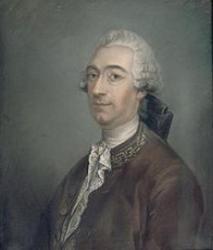
Claude Crebillon
 France
- A literary name of his own
- Scandal, satire and exile
- Marriage and private loss
- The author becomes a censor
- Later writing and legacy
Claude-Prosper Jolyot de Crébillon became famous for writing about seduction, social maneuvering and the private games of the French elite. His novels could be playful and erotic, yet often carried sharp political or religious satire. Twice the authorities punished him for what he wrote; later, he himself became a royal censor. Known as Crébillon fils, he was the son of a celebrated tragedian and developed a literary voice very different from his father’s.
A literary name of his own
Born in Paris in 1707, Crébillon grew up in the shadow of his father, Prosper Jolyot de Crébillon, a leading French tragedian and member of the Académie française. The younger writer adopted the distinguishing name “Crébillon fils” (“Crébillon the son”), but he did not follow his father into tragic drama. He gravitated instead toward songs, satire, short fiction and the lively world of Parisian literary gatherings.
He began publishing in 1730 with Le Sylphe, a witty tale framed as a woman’s account of a supernatural visitor. His early writing introduced a method he would refine throughout his career: using intimate conversations, letters and playful narrative devices to reveal how people maneuvered around love, reputation and power.
Scandal, satire and exile
In 1734, Crébillon published Tanzaï et Néadarné, also known as L’Écumoire. Set in an imaginary, distant world, the book combined fantasy with pointed allusions to religious disputes and political figures in France. The disguise was thin enough to attract official attention. Crébillon was imprisoned at Vincennes for several weeks, a striking beginning for a writer whose work would repeatedly test the limits of censorship.
His next major novel, Les Égarements du cœur et de l’esprit, appeared in installments from 1736 to 1738 and remained unfinished. Told by the young Meilcour, it follows his education in the rituals and traps of high society. The novel’s wit comes from the distance between what its characters say about love and what they actually want. Meilcour’s mentor, the experienced libertine Versac, and the accomplished Madame de Lursay help expose a social world where seduction is a kind of strategy and vulnerability can be used as leverage.
Crébillon’s best-known work, Le Sopha, appeared in 1742. Its narrator is a man whose soul has been reincarnated in a sofa; he can return to human form only after witnessing two people make love on him. From that unusual vantage point, the narrator recounts the affairs and hypocrisies of an imagined court. The novel’s sensual comedy also carried a satirical charge, and authorities interpreted its fictional ruler as a possible caricature of Louis XV. Crébillon was banished from Paris for a time.
Marriage and private loss
Away from the public scandals, Crébillon formed a lasting attachment. He met an English noblewoman, Henrietta Maria Stafford, in 1744. They had a son in 1746 and married in 1748. She died in 1756, a loss that biographical accounts say he never fully overcame. His writing continued to draw readers into the polished world of flirtation and courtship, but the private record offers a more restrained picture than the libertine reputation his novels created.
The author becomes a censor
One of the most surprising turns in Crébillon’s career came in 1759, when, with the support of Madame de Pompadour, he received an appointment as royal censor. He had previously felt the force of censorship himself: imprisonment over Tanzaï et Néadarné and exile following Le Sopha. In 1774 he also became a police censor.
The role was not simply a reversal of his earlier troubles. Censors reviewed manuscripts and could authorize publication, and later scholarship based on archival registers describes Crébillon as an active reader who approved many works. He moved from being a writer suspected of hidden criticism to a gatekeeper in the system that controlled what could be printed.
Later writing and legacy
Crébillon continued publishing after the works that made his name. His later titles included Les Heureux Orphelins (1754), La Nuit et le Moment (1755), Le Hasard au coin du feu (1763), Lettres de la duchesse de *** au duc de *** (1768) and Lettres athéniennes (1771). These works maintained his interest in social codes, desire and the compromises people made to protect their standing.
He died in Paris on April 12, 1777. For a time, more moralizing criticism pushed his novels into relative obscurity, but his work has since drawn renewed attention for its psychological subtlety and its sharp observation of elite society. Crébillon’s fiction lives in the tension between performance and feeling: his characters are witty strategists, but beneath their games is a persistent question about whether sincere love can survive in a world organized around advantage.