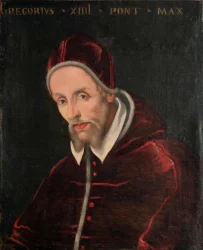
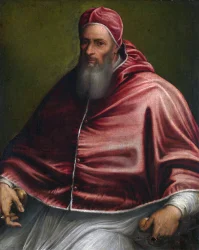
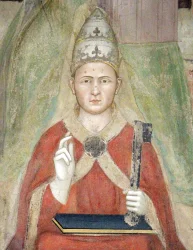
Gregory XIV
Gregory XIV became pope at a moment when the Catholic Church’s struggles were entangled with the succession crisis in France. His pontificate lasted less than a year, yet he took a forceful position in the French Wars of Religion, backing the Catholic League against the Protestant Henry of Navarre, who had inherited the French crown as Henry IV. Remembered as personally devout and serious, he nevertheless made decisions that strengthened Spain’s influence and drew the papacy deeper into a foreign civil conflict.
A cleric formed by reform
Born Niccolò Sfondrati on February 11, 1535, in Somma Lombardo in northern Italy, he grew up in a family connected to the Church and public life. He studied law and took religious vows, later becoming bishop of Cremona in 1560. He attended the Council of Trent, the gathering that set out reforms and doctrine in response to the Protestant Reformation. The experience placed him within a generation of Catholic leaders seeking to strengthen discipline and renew the Church after decades of religious conflict.
Sfondrati was made a cardinal in 1583. After Pope Urban VII died in September 1590, a long conclave ended with Sfondrati’s election on December 5. He chose the name Gregory XIV. His election followed months of negotiation, with the Spanish faction influential in the choice. He had a reputation for piety and conscientiousness, but the circumstances of his election also tied his papacy to the competing powers of Catholic Europe.
The French succession crisis
France was in turmoil after the assassination of King Henry III in 1589. Under the customary rules of succession, Henry of Navarre became the heir, but he was Protestant in a predominantly Catholic kingdom. The Catholic League rejected his claim and sought a Catholic monarch. Gregory supported the League, which was aligned with Spain, and in 1591 excommunicated Henry IV and those who continued to support him. The move was intended to deny Henry religious legitimacy and pressure French Catholics to abandon his cause. It instead made the pope an active participant in a conflict whose outcome would be decided by French politics and war.
Gregory sent financial aid and troops to support the League, including a force under his nephew Ercole Sfondrati. His actions were a striking example of how papal authority could be deployed in dynastic and military struggles. His pontificate also relied on family connections at home: another nephew, Paolo Camillo Sfondrati, was elevated to the cardinalate and given an important position in the papal administration. These appointments reflected common patterns of Renaissance and early modern papal governance, but they also exposed the tension between reforming ideals and family patronage.
A short papacy and a long shadow
Gregory’s brief reign included more than foreign policy. In March 1591, his bull Cogit nos forbade betting on the election of a pope, the length of a pontificate, or the appointment of new cardinals, under penalty of excommunication. The decree responded to the practice of wagering on the outcomes of conclaves, turning a political spectacle into a formal matter of church discipline.
Gregory XIV died in Rome on October 16, 1591, after a pontificate of just over ten months. His interventions in France did not resolve the succession crisis, but they reveal the limits and reach of papal power in a Europe divided by confession and political rivalry. His legacy is less that of a long-serving reformer than of a conscientious churchman whose short rule was shaped by the pressure of the Catholic League, Spanish influence, and a contested French throne.