Nicholas V
- A scholar rises through the Church
- Rome as a center of learning
- A papacy tied to conquest
- A humanist pope and his contradictions
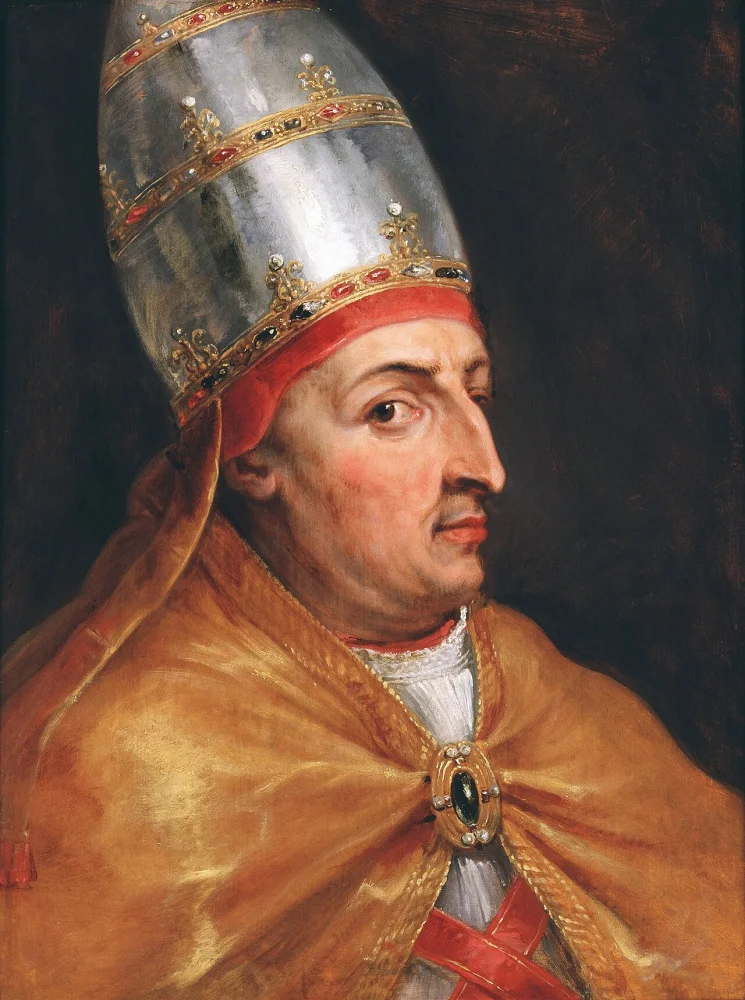
Nicholas V brought the energy of Renaissance humanism to the papal court. A scholar before he became pope, he imagined Rome as both the spiritual capital of western Christianity and a renewed center of classical learning. His patronage helped lay the groundwork for the Vatican Library and major building projects. Yet his pontificate also authorized Portuguese conquest and enslavement in Africa, a policy that tied papal authority to the expansion of European empire. His legacy holds intellectual ambition and imperial violence side by side.
A scholar rises through the Church
Born Tommaso Parentucelli on November 15, 1397, in Sarzana, in what is now northern Italy, he studied in Bologna and Florence. He worked as a tutor and came into contact with influential humanist scholars. His learning and administrative skill attracted the attention of Cardinal Niccolò Albergati, under whose patronage he advanced through church offices, eventually becoming bishop of Bologna.
Parentucelli took part in the Council of Ferrara-Florence, where efforts were made to reunite the Latin and Greek churches. After Pope Eugenius IV died, he was elected in 1447 and took the name Nicholas, honoring his former patron. The Western Schism had recently ended, and one of his central tasks was to strengthen papal authority after decades of division. In 1448, he reached an agreement with the German king Frederick III that helped settle disputes between the papacy and the empire.
Rome as a center of learning
Nicholas brought manuscripts and scholars to the papal court, supported the translation of Greek works into Latin, and planned a substantial library in the Apostolic Palace. This collection became an important foundation for the Vatican Library as it developed under later popes. He also envisioned a transformed Rome, commissioning work on churches, fortifications, and the Vatican quarter. The projects reflected Renaissance ideals of learning and civic grandeur, while reinforcing the power of the papacy in its capital.
The Jubilee of 1450 drew pilgrims from across Europe and brought renewed prestige and revenue to Rome. The celebrations also exposed the risks of mass pilgrimage: a deadly crowd crush on the bridge to Castel Sant’Angelo killed many visitors. Nicholas’s pontificate thus mixed spiritual spectacle, urban renewal, and the practical burdens of governing a city receiving an enormous influx of people.
A papacy tied to conquest
The Ottoman conquest of Constantinople in 1453 shocked Christian Europe. Nicholas called for a crusade to recover the city, but the effort gained little military support and failed to reverse the Ottoman advance. His pontificate also marked a more troubling extension of papal authority. In the bull Dum Diversas of 1452, he authorized Portugal’s King Afonso V to wage war against non-Christian peoples and to reduce them to perpetual enslavement. The decree was part of a wider history of Christian imperial claims, but its language and consequences helped legitimize the enslavement of Africans and Portuguese expansion along the West African coast.
A humanist pope and his contradictions
Nicholas died in Rome on March 24, 1455. He is often described as the first Renaissance pope because of the scale of his literary and architectural patronage. His vision helped shape how later popes used art, scholarship, and urban planning to present the papacy as both spiritual authority and cultural power.
The same office that sponsored libraries and restored Rome also issued a grant that empowered conquest and enslavement. Nicholas V’s life cannot be reduced to either his cultural achievement or his complicity in imperial violence. His pontificate reveals how Renaissance learning and Christian authority could flourish alongside policies that inflicted lasting harm on people beyond Europe.