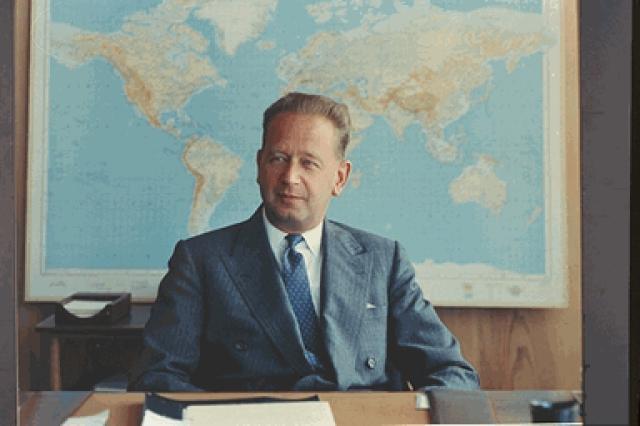
Dag Hammarskjold
 Sweden
- Scholar and Civil Servant
- Secretary-General in a Divided World
- The Congo Crisis
- Final Mission and Legacy
Dag Hammarskjöld led the United Nations through some of its earliest and most dangerous tests. As its second Secretary-General, he helped establish a more independent international civil service and expanded the organization’s role in peacekeeping, especially during the Suez crisis and the Congo crisis. His diplomatic career ended in 1961, when he died in a plane crash while traveling on a mission to the Congo.
Scholar and Civil Servant
Born in Jönköping, Sweden, on July 29, 1905, Hammarskjöld was the youngest son of Hjalmar Hammarskjöld, who served as Sweden’s prime minister during the First World War. He grew up in Uppsala, where his father was governor, and developed early interests in literature, languages, philosophy and public affairs.
At Uppsala University, Hammarskjöld studied French literature, social philosophy and political economy, then continued with graduate work in economics. He earned a doctorate in 1933. His first career was in public administration: he worked in Sweden’s finance ministry and central bank, handling economic and financial policy during a period of profound change in Europe. He later moved into foreign affairs and became a senior Swedish diplomat. In 1951, he was appointed deputy foreign minister and represented Sweden at the United Nations.
Secretary-General in a Divided World
In 1953, Hammarskjöld was elected Secretary-General, taking office during a tense phase of the Cold War. He worked to strengthen the UN Secretariat as an international civil service that could act with independence from individual governments. The post demanded both administrative discipline and political judgment, as the organization faced conflicts that drew in competing global powers.
The 1956 Suez crisis became a defining test. Hammarskjöld helped secure a ceasefire and organize the United Nations Emergency Force, an early armed peacekeeping operation. The effort helped establish a model for UN peacekeeping and showed how the organization could help separate opposing forces while diplomacy continued.
The Congo Crisis
In 1960, after the Republic of the Congo gained independence from Belgium, the country faced mutiny, political conflict and the secession of Katanga. Hammarskjöld oversaw the UN Operation in the Congo, which had been deployed at the Congolese government’s request. The mission sought to support stability and the country’s territorial integrity, while avoiding an open alignment with either side of the Cold War.
His approach attracted sharp criticism from different governments and political factions. The crisis raised difficult questions about the limits of UN authority, the protection of national sovereignty and the risks of remaining neutral amid a violent conflict. Hammarskjöld continued to pursue a political settlement and personally traveled to meet Katanga’s leader, Moïse Tshombe.
Final Mission and Legacy
On the night of September 17–18, 1961, the plane carrying Hammarskjöld and members of his party crashed near Ndola, in what was then Northern Rhodesia and is now Zambia. All 16 people aboard died. He was on a peace mission, seeking to advance negotiations in the Congo. The crash’s cause has never been conclusively established; successive inquiries have examined the circumstances, and later UN reviews have said important questions and information remain unresolved.
The Nobel Committee awarded Hammarskjöld the 1961 Nobel Peace Prize posthumously, recognizing his work to strengthen the United Nations and advance peace. He was also a member of the Swedish Academy. His private journal of spiritual and personal reflections, later published as Markings, revealed a quieter dimension of a life otherwise spent in public service. Together, his diplomacy and writing left an enduring portrait of a leader who treated international service as both a demanding duty and a personal calling.


