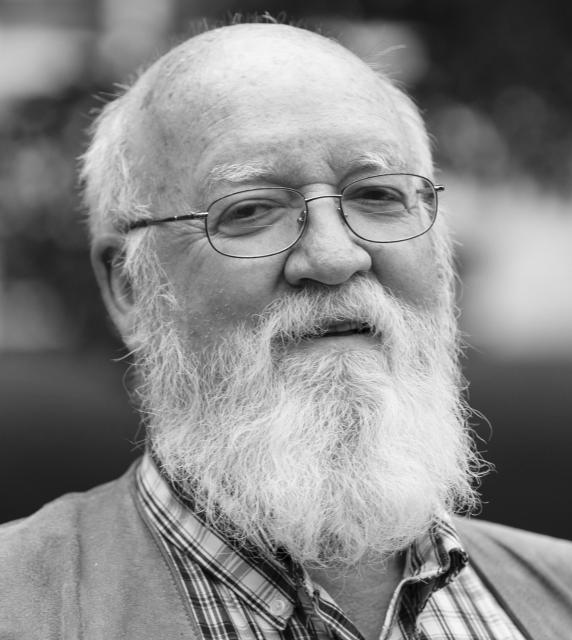
Daniel Dennett
 USA
USA- Biography of Daniel Dennett
- Education and Early Career
- Philosophical Contributions
- Consciousness and Language
- Major Publications
Biography of Daniel Dennett
Daniel Dennett is an American philosopher known for his contributions to the field of philosophy of mind and cognitive science. He was born on March 28, 1942 in Boston, Massachusetts. He received his education at Harvard University and Oxford University.
Education and Early Career
Dennett completed his doctoral studies at Oxford University under the supervision of Gilbert Ryle. In 1965, he became a professor at the University of California and later joined the faculty of Tufts University in 1971, where he holds the position of Professor of Philosophy.
Philosophical Contributions
Dennett's work is heavily influenced by his mentors, Willard Van Orman Quine and Gilbert Ryle. He is known for his strictly naturalistic and anti-Cartesian conception of consciousness, and his exploration of the empirical foundations of consciousness, offering original philosophical interpretations of natural phenomena.
Dennett's writings combine philosophical arguments with concrete examples that appeal to the reader's direct experience. In the philosophical community, he is primarily known for his concept of "intentional stance." According to Dennett, to understand an individual's past and predict their future actions, one must consider their beliefs and desires. He argues that this applies not only to human behavior, but also to biological phenomena, such as the behavior of red blood cells.
Dennett also proposes alternative approaches, such as the "design stance" or physicalist stance, which explain behavior by referring to a predetermined plan or the laws of physics. He challenges the notion that only humans have beliefs and desires, arguing that different types of consciousness exist in various beings.
Consciousness and Language
Dennett argues that having mental states does not necessarily mean having consciousness. He suggests that the ability to represent one's own mental states, which is closely associated with language, is essential for conscious mental states. According to Dennett, creatures without language do not possess consciousness, even if they exhibit mental states.
Major Publications
Some of Dennett's notable works include "Content and Consciousness" (1969), "Intentional Stance" (1987), and "Consciousness Explained" (1991). These books explore the nature of consciousness and offer unique perspectives on the philosophical understanding of the mind.


