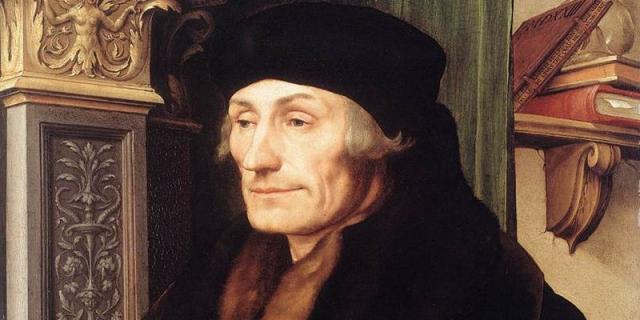
Desiderius Erasmus
 Netherlands
- Biography of Desiderius Erasmus
- Formation of Erasmus's Creative Personality
- Christian Humanism
- Major Works
Biography of Desiderius Erasmus
Desiderius Erasmus, also known as Erasmus of Rotterdam, was a Dutch scholar, humanist, writer, philologist, and theologian. He was one of the most prominent figures of the Northern Renaissance. Erasmus received his education at the University of Paris from 1495 to 1499. He lived in France, England, Germany, Italy, and Switzerland, and he gained recognition throughout Europe. He wrote in Latin, the universal language of educated Europe at that time.
Formation of Erasmus's Creative Personality
The formation of Erasmus's creative personality was influenced by Dutch mysticism, humanistic education, and the Oxford reformers, such as John Colet, who advocated for a new, in-depth, and scientifically grounded interpretation of Christian sacred texts. Erasmus achieved the first printed edition of the Greek original of the New Testament with his extensive commentaries in 1517, as well as his own Latin translation in 1519. He created a systematic new theology called "the philosophy of Christ," which focused on man's relationship with God and the moral obligations of man before God. Erasmus considered speculative theology issues such as the creation of the world, original sin, and the Trinity as having no vital importance and fundamentally unsolvable.
Christian Humanism
Erasmus became the leader of the movement known as Christian humanism. He opposed the stagnation of the church, the veneration of relics, monastic parasitism, and hypocrisy, as well as the rituals lacking spiritual meaning. Therefore, he became a precursor of the Reformation. However, he was also consistent in his rejection of fanaticism, rigid dogmatism, and the excessive humiliation of man before God, which were characteristic of Lutheranism. As a result, he broke with Martin Luther, whom he had previously supported. Erasmus's position did not satisfy any of the warring sides, and he was forced to flee from Leuven and Basel to escape religious fanaticism.
Major Works
Erasmus's extensive literary legacy includes his most famous works, "The Praise of Folly" (1509) and "Colloquies" (1519-1535). The former is a satirical philosophical work, and the latter primarily consists of everyday conversations. Both works are based on the conviction of the contradictions of all existence and the tenuous boundary between opposites. The Lady Folly, who praises herself, easily turns into wisdom, self-righteousness turns into stupidity, and unlimited power becomes the worst form of slavery. Therefore, the most precious rule of life becomes the call for "nothing in excess." This conviction represents the ideological position of Erasmus, which is also evident in his other works.
Erasmus's literary works also include a significant number of pedagogical, moral instructive, and theological writings. Among them are the anti-Lutheran treatise "On the Freedom of the Will" (1524) and "On the Dignified Education of Children from Their Early Years" (1529). Erasmus's extensive correspondence, in which he exhibited great mastery of the epistolary genre, has also been preserved.



