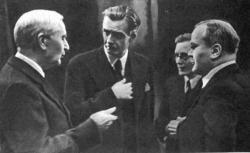
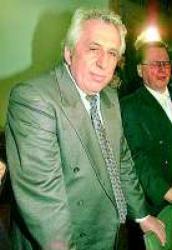
Dimitar Gichev
 Bulgaria
- Dimitar Gichev: A Bulgarian Political Figure
- Early Activism and Imprisonment
- Founding and Leading BZNS "Vrabcha-1"
- Ministerial Positions and Reforms
- Opposition and imprisonment
- Later Life and Legacy
Dimitar Gichev: A Bulgarian Political Figure
Dimitar Gichev, a Bulgarian political leader, was a prominent figure in the Bulgarian Agrarian National Union (BZNS). Hailing from a humble background, he completed his education at the Sofia Theological Seminary.
Early Activism and Imprisonment
In his youth, Gichev joined the BZNS. During World War I, he served in the army but was convicted for participating in anti-war activities. After the war, he organized the BZNS in Plovdiv (1919-1920) and later in the Plovdiv region (1921-1923). In 1923, he was elected to the 20th Ordinary National Assembly.
Following a coup on June 9, 1923, Gichev went into hiding, but was arrested and imprisoned. After his release, he was arrested again in 1925, convicted, but later amnestied.
Founding and Leading BZNS "Vrabcha-1"
From 1926 to 1944, Gichev established and led BZNS "Vrabcha-1," the right wing of the agrarian movement. Between 1927 and 1934, he served as a deputy in the 22nd (where he was secretary of the BZNS parliamentary group) and 23rd Ordinary National Assembly.
Ministerial Positions and Reforms
Gichev played a role in the Народен блок (National Bloc), which won the parliamentary elections in 1931. He served as the Minister of Agriculture and State Property from June 29, 1931, to December 31, 1932, in the governments of Alexander Malinov and Nikola Mushanov. He passed a law protecting peasants, suspending the sale of land for debts, introducing installments for repaying debts, and reducing their overall amount. Additionally, small landholdings (up to 4 hectares) were declared non-alienable. According to the state budget law, land tax on the first hectare of each holding was eliminated. The government also partially canceled and reduced tax arrears.
From December 31, 1932, to May 19, 1934, Gichev served as the Minister of Trade, Industry, and Labor. Simultaneously, from December 31, 1932, to January 18, 1933, he was the acting Minister of National Education in the Mushanov government. However, his efforts to gain the coalition partners' approval for a new law reducing debts and raising agricultural product prices were unsuccessful. Disagreements within the cabinet contributed to a coup on May 19, 1934, which overthrew the Mushanov government.
Opposition and imprisonment
Subsequently, Gichev entered opposition. He was detained in the Klisurski Monastery and demanded the restoration of the Tarnovo Constitution, accusing the government of establishing a dictatorship. He was tried and sentenced to one year in prison but was acquitted upon appeal. Gichev was a deputy in the 24th Ordinary National Assembly from 1938 to 1939.
During World War II, he opposed collaboration with Germany, but did not join the Fatherland Front, which had a significant communist presence. He briefly held the position of Minister without Portfolio in the government of Konstantin Muraviev from September 2 to 9, along with other members of Muraviev's government. They were tried by the People's Court and sentenced to one year in prison, which effectively ended Gichev's political career under the Fatherland Front government. However, the Supreme Court overturned the verdict in 1996.
Later Life and Legacy
Released from prison in September 1945, Gichev became active again. He participated in the unification conference of BZNS "Vrabcha-1" and BZNS "Nikola Petkov" in November 1945, delivering a speech entitled "For a United Agrarian Union - the Support and Hope of the Bulgarian People."
On December 31, 1947, he was arrested and charged with organizing armed groups (chetas), sabotage, and spreading rumors. He denied the charges, and in 1948, he was sentenced to life in prison. Gichev refused to compromise with the authorities and spent the first eight years of his sentence in solitary confinement. He was held in Pleven Prison and was finally released on August 8, 1960.
In Sofia, a monument commemorates three leaders of the agrarian movement: Dimitar Gichev, Nikola Petkov, and Dr. G. M. Dimitrov ("Gemeto").