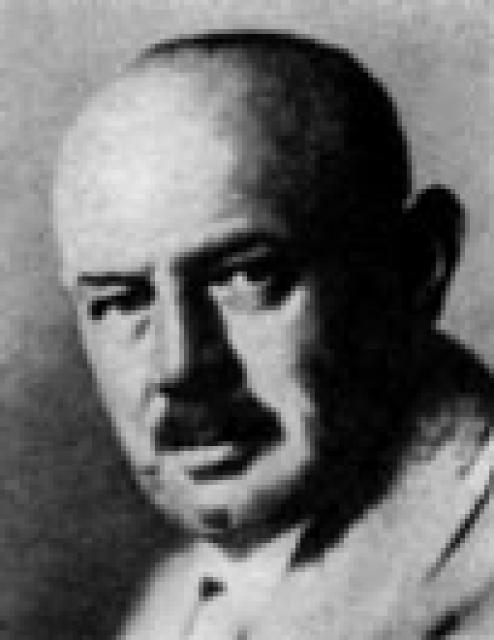
Ditryh Eckart
 Germany
Dietrich Eckart: A Biography
Dietrich Eckart (23.3.1868, Neumarkt - 23.12.1923, Berchtesgaden) was a poet and one of the founders of the Nazi Party. He was also a journalist. In his youth, he struggled with addiction, particularly to morphine, and there are reports that he spent some time in a psychiatric institution. Additionally, Eckart had a problem with alcohol abuse. He lived in Berlin but returned to Bavaria in 1918.
Political Activism
Eckart actively opposed the revolution of 1918, which he believed was inspired by Jews. He translated Henrik Ibsen's "Peer Gynt" into German. He wrote the poem "Jörgito" (1919), from which the line "Germany, awake!" ("Deutschland erwache!") became a prominent slogan in Nazi propaganda and was embroidered on the party's flag. In 1919, prior to Adolf Hitler, Eckart joined the German Workers' Party (DAP) and became a member of its Committee. He participated in the Kapp Putsch.
Collaboration with Adolf Hitler
After the acquisition of the newspaper "Völkischer Beobachter" in December 1920, Eckart became its co-editor alongside Alfred Rosenberg until 1922. He actively supported Hitler, accompanying him to rallies, writing laudatory articles about him, and becoming his advisor. Eckart introduced Hitler to his circle of influential acquaintances, who provided financial support to the party. He was one of Hitler's closest friends, addressing him informally. Hitler greatly valued Eckart's loyalty, later referring to him as a "teacher" and "Polar Star." He recognized Eckart's invaluable contribution to the formation of the Nazi movement, stating that he was "one of the best who devoted his life to awakening our people through his creativity, thoughts, and actions."
Legacy
Eckart's poem "Sturm" became one of the most popular Nazi songs. He authored the book "Bolshevism from Moses to Hitler" (Munich, 1923), in which he engaged in a dialogue with an imaginary interlocutor who bore a resemblance to Hitler. Eckart argued that the secret force behind the disruption of the world's historical order was the Jews. According to him, Hitler was the first to realize that the exodus of the Jews from Egypt was intended to carry out a bloody revolutionary assault on the established order, and that Moses was none other than the leader of Bolshevism. Hitler frequently incorporated Eckart's ideas into his speeches.
In 1923, Eckart fell seriously ill. He died from a heart attack (according to other sources, from a form of typhus). Historians of Nazism often refer to Eckart as the "spiritual father of National Socialism."


