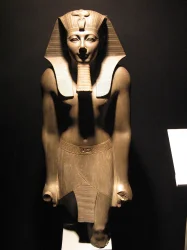
Djoser
Djoser stands at a turning point in ancient Egyptian architecture. Under his rule in the Third Dynasty, builders at Saqqara transformed the traditional royal tomb into a vast stone monument: the Step Pyramid and its surrounding ceremonial complex. The king himself remains difficult to picture from written records, but the scale of this construction project made his name one of the most enduring in Egyptian history.
A king known by two names
Djoser is usually placed in the twenty-seventh century BCE, though exact dates for his reign are uncertain. Contemporary inscriptions identify him primarily by the Horus name Netjerikhet; the name Djoser became common in later sources. He is generally regarded as the first king of Egypt’s Third Dynasty and a successor to the rulers who had consolidated the early state.
Very little is known about his private life or personality. Most of what historians can say about his reign comes from monuments, inscriptions, and later king lists. These sources suggest a period when royal power and the administration of the state were becoming more centralized, enabling the organization of large building projects.
The Step Pyramid at Saqqara
Djoser’s most famous monument is the Step Pyramid at Saqqara, near the ancient capital of Memphis. Rather than a smooth-sided pyramid, it rises in a series of stepped levels, created through successive expansions of a mastaba-style tomb. Built primarily from stone, it became the centerpiece of an enormous walled funerary complex with courts, shrines, and ceremonial spaces.
The project marked a major shift in Egyptian architecture. Earlier royal tombs were largely built of mud brick, while Djoser’s complex used limestone on an unprecedented scale. Its design established a new model for royal burial and helped set the stage for the later pyramids of the Old Kingdom.
The official Imhotep is traditionally credited as the architect of the complex. His name appears on a statue base found at the site, and later Egyptian and Greek traditions remembered him as a remarkable scholar and builder. The precise details of his role are not fully preserved, but his association with Djoser’s monument became inseparable from its story.
Monument and legacy
The Step Pyramid was more than a tomb. Its courtyards and symbolic buildings represented the rituals of kingship and the ruler’s hoped-for life beyond death. The scale and careful planning of the complex show the resources available to Djoser’s administration and the skill of the workers who shaped it.
Over centuries, Djoser became a figure of memory and legend. Later stories attached his name to events such as a seven-year famine, but those accounts were written long after his reign and cannot be treated as contemporary history. The archaeological record remains the clearest guide to his achievement.
Djoser’s reign is remembered chiefly through stone. The Step Pyramid still dominates the Saqqara landscape, a monument that records a bold architectural experiment and a powerful vision of Egyptian kingship. It marks an early stage in the long history of pyramid building and remains one of the most important surviving works of Egypt’s Old Kingdom.