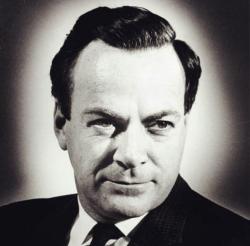
Djulius Schwinger
 USA
USA- American Theoretical Physicist, Co-founder of Quantum Electrodynamics
- Manhattan Project and Post-War Career
- Contributions to Physics
- Personal Life and Honors
American Theoretical Physicist, Co-founder of Quantum Electrodynamics
Early Life and EducationJulius Seymour Schwinger was born in New York City and graduated from high school at the age of 14. He then enrolled at the City College of New York, where he began working on independent papers in quantum mechanics. One of these papers, published in Physical Review, caught the attention of I.I. Rabi.
Rabi arranged for Schwinger to receive a special scholarship to Columbia University, from which he graduated with a B.A. in 1936. He continued his education as a fellow at the University of Wisconsin-Madison and Purdue University before returning to Columbia University in 1939 to earn his Ph.D.
Manhattan Project and Post-War Career
After receiving his doctorate, Schwinger remained at Columbia as a National Research Council Fellow for one year before spending the next year as a research associate at the University of California, Berkeley. In 1941, he moved to Purdue University as a research fellow and then an assistant professor.
In 1943, he joined the effort to build the atomic bomb at the University of Chicago's Metallurgical Laboratory, part of the Manhattan Project. Later that year, he moved to the Massachusetts Institute of Technology to work on improving radar systems.
After the war, he became an associate professor and then a full professor of physics at Harvard University in 1946. In 1973, Schwinger joined the University of California, Los Angeles as a professor of physics.
Contributions to Physics
Schwinger's early interest in the fundamental nature of matter led to his groundbreaking work in theoretical physics, which culminated in the unification of quantum mechanics and special relativity. In 1965, he shared the Nobel Prize in Physics with Richard Feynman and Sin-Itiro Tomonaga for "their fundamental work in quantum electrodynamics, with deep-reaching consequences for the physics of elementary particles."
In addition to his work on quantum electrodynamics, Schwinger made significant contributions to nuclear physics and electrodynamics (waveguide theory). He also conducted extensive work in theoretical physics of elementary particles, taking his own unique approach.
Personal Life and Honors
In 1947, Schwinger married Clarice Carroll. They had no children.Besides the Nobel Prize, he received the Columbia University University Medal (1951), the Albert Einstein Award from the Lewis and Rosa Strauss Memorial Fund (1951), and the National Medal of Science from the National Science Foundation (1964). He was awarded honorary degrees from Purdue, Harvard, Brandeis, and Columbia universities.
Schwinger was a member of the U.S. National Academy of Sciences, the American Physical Society, the New York Academy of Sciences, the American Association for the Advancement of Science, and the American Academy of Arts and Sciences.