William Barrett
 Great Britain
- Biography of William Barrett
- Academic Career
- Interest in the Paranormal
- Contributions to Psychical Research
Biography of William Barrett
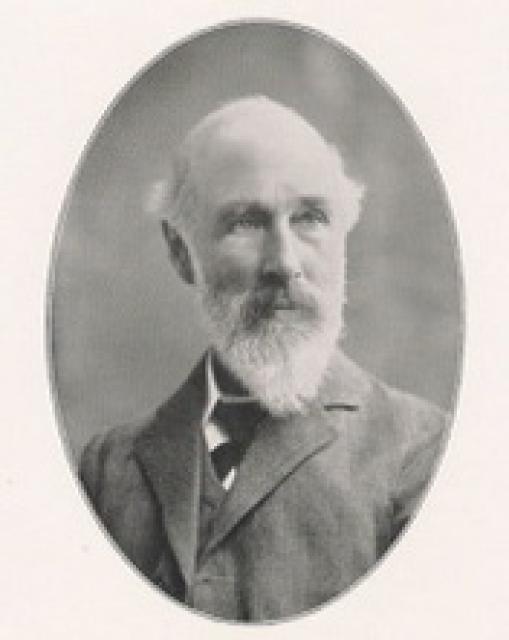
Early Life and EducationWilliam Fletcher Barrett, a British physicist known for his expertise in optics and electrical engineering, was also renowned as a researcher of paranormal phenomena associated with spiritualism. He was born in Jamaica, where his father, William Garland Barrett, served as a missionary and was a naturalist and member of the London Missionary Society. In 1848, the family returned to their homeland, Royston, Hertfordshire. Barrett attended Old Trafford Grammar School in Manchester and later studied at the International College under the guidance of the renowned physicist John Tyndall, working as his assistant from 1862 to 1867.
Academic Career
In 1873, Barrett became a professor at the Royal College of Science in Dublin, where he taught for thirty years until his retirement in 1910. During this time, he became an honorary member of the Royal Society, the Philosophical Society, the Royal Literary Society, and the Royal Irish Academy. Barrett's research and experiments on the creation of new metallic alloys, particularly silicon-iron alloys known as Stalloids, were of great practical significance in the production of early telephones and transformers. He was a pioneer in the field of entoptic optics, and his research led to the discovery of the entoptiscope and a new model of optometer. In recognition of his contributions to science, he was awarded the Order of the British Empire (OBE) in 1912.
Interest in the Paranormal
Barrett's interest in paranormal phenomena observed during spiritualist séances developed after he learned about the research of William Crookes. At the age of twenty-nine, Barrett began experimenting with mesmerism, also known as hypnotism, primarily studying the possibilities of clairvoyance and telepathy. After confirming the reality of certain types of spiritualistic phenomena, he decided to undertake their scientific investigation. In his book "On the Threshold of the Unseen" (1917), Barrett wrote that his initial theories crumbled in 1876 after he met an English lawyer named Clarke, who spent the summer near his home in Dublin. Clarke's ten-year-old daughter, Florrie, demonstrated paranormal phenomena in the presence of witnesses, including unexplained rapping sounds and levitation. She was guided by a "spirit" calling itself "Walter." Barrett documented all the results of his observations, both of subjects in trance and of Florrie, in a report he submitted to the British Association for the Advancement of Science. The association not only rejected Barrett's report but also refused his proposal to present it orally to a group of scientists. Alfred R. Wallace, William Crookes, and Lord Rayleigh protested, and Barrett was eventually allowed to present his report but was prohibited from publishing it. Barrett continued to observe mediums, including Esther Travers Smith, Gladys Osborne Leonard, and Geraldine Cummins.
Contributions to Psychical Research
In 1882, Barrett became one of the founders of the Society for Psychical Research (SPR), but as he resided in Dublin, he had limited opportunities to actively participate in its work. He entrusted leadership to his colleagues, scientists from Cambridge, Henry Sidgwick, Frederic W. H. Myers, and Edmund Gurney. It was Barrett who persuaded Harvard University professor William James to organize the American branch of the SPR in 1884. From 1884 to 1899, Sir William Barrett served as the editor-in-chief of the SPR Journal, and in 1904, he held the position of president of the SPR. Barrett also gained recognition as a researcher of deathbed visions, with his book "Deathbed Visions" (1926) remaining popular to this day.