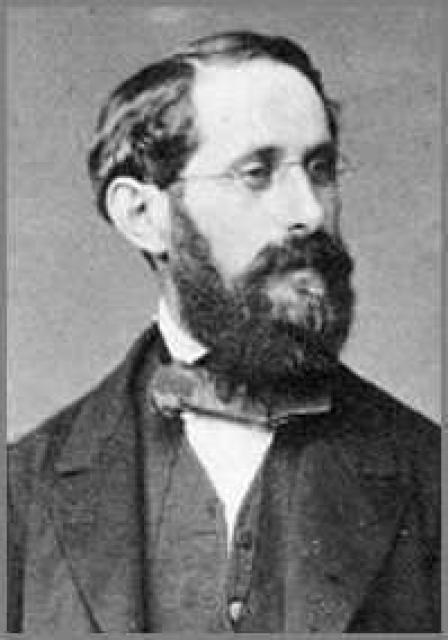
Eduard Heine
 Germany
Early Life and Education
Eduard Heine was born on March 15, 1821, in Delitzsch, Germany. He pursued his passion for mathematics at the prestigious University of Göttingen, the Humboldt University of Berlin, and the Albertina University in Königsberg (now Kaliningrad).
Academic Career
Upon completing his studies, Heine embarked on an academic career. He taught mathematics as a professor at the universities of Bonn and Halle. During his tenure at Halle, he delved deeply into the field of potential theory, function theory, and differential equations, making significant contributions to each.
Contributions to Mathematics
Heine's research has left an indelible mark on mathematics. His work on the theory of integration laid the foundation for the Cantor-Heine theorem, which provides a precise definition of uniform convergence. Another notable contribution is the Heine-Borel theorem, which establishes necessary and sufficient conditions for the compactness of a subset of the real numbers.
Legacy and Impact
Eduard Heine passed away on October 21, 1881, in Halle. His contributions to mathematics continue to be recognized and celebrated today. The Heine definition of the limit of a function remains a fundamental concept in calculus, and his name is associated with several theorems that bear his name.



