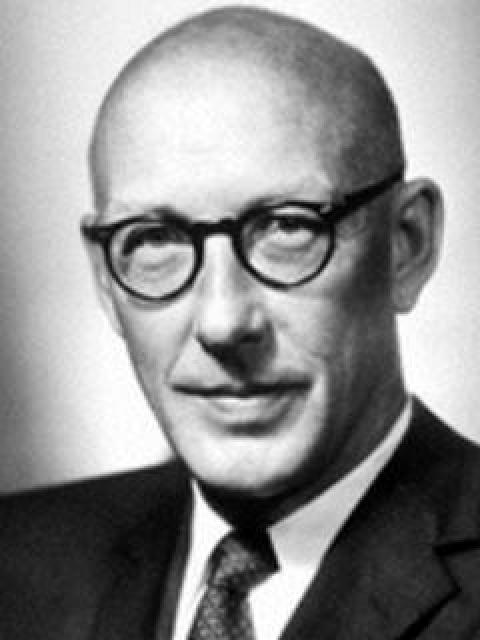
Edward Lawrie Rebeta-Berdit
 USA
USABiography of Edward Lawrie Tatum
Edward Lawrie Tatum was an American geneticist and biochemist, and a Nobel Prize laureate in Physiology or Medicine in 1958. He was born in Boulder, Colorado, and was the eldest of three children of Arthur Lawrie Tatum, a physician and pharmacologist at the University of Wisconsin, and Mabel (Webb) Tatum, one of the first women to graduate from the University of Colorado.
Tatum received his early education at the Experimental School of the University of Chicago. He spent two years at the university before transferring to the University of Wisconsin, where he earned a bachelor's degree in 1931 and a master's degree in natural sciences in 1932. In 1934, he obtained his Ph.D. by defending a dissertation on the nutritional and cellular biochemistry of bacteria. He then worked as a research biochemist at Wisconsin and received a fellowship from the National Education Department to study at Utrecht University in the Netherlands for a year. After returning to the US in 1937, Tatum worked as a research assistant in the Department of Biological Sciences at Stanford University in California, where he became an assistant professor four years later. His early research at Stanford focused on studying the nutritional and cellular biochemistry of microorganisms. He discovered that the pink bread mold, Neurospora cracca, required biotin, a vitamin from the B-group, for growth. He also described the nutritional requirements of the fruit fly, Drosophila, which is commonly used for genetic research, and identified kynurenine, a substance that affects the color of its eyes.
In the early 1940s, Tatum collaborated with geneticist George W. Beadle, a professor at Stanford, to investigate the chemical processes involved in the genetic mechanisms of Neurospora. They conducted experiments on the organism to understand how genes control the synthesis of specific cellular substances. Tatum and Beadle grew colonies of Neurospora in a minimal culture medium and exposed them to X-rays to induce mutations. They found that certain colonies grew normally but could not reproduce in the minimal medium, leading them to focus on these colonies. They transplanted cells from these colonies onto a thousand different culture media, each containing a specific substance that normal Neurospora can synthesize. The mutants that grew on the 199th medium, which contained vitamin B6, indicated that the mutation induced by radiation affected the gene responsible for synthesizing this vitamin. To confirm that the defect was genetic, Tatum and Beadle crossed the vitamin B6-deficient strain of Neurospora with a normal strain and found that the defect was inherited as a recessive trait, according to Mendelian genetics. These experiments provided evidence for the control of specific genes over the synthesis of specific cellular substances.
Tatum's findings and the laboratory techniques he developed played a crucial role in increasing the production of penicillin during World War II. Penicillin is synthesized by a fungus, and Tatum's methods allowed for the efficient production of this antibiotic when it was most needed. In 1944, Tatum served as a civilian in the United States Army Service Forces for scientific research and development.
By the end of the war, Tatum became a professor of botany at Yale University in 1946. He worked with Joshua Lederberg, a young medical student at Columbia University, and together they demonstrated that bacterial cells, similar to fungi and higher organisms, reproduce sexually through a process they called genetic or sexual recombination. Genetic recombination in bacteria involves the temporary fusion of two individual bacterial cells to form a third cell, which inherits traits from both parental cells. In 1948, Tatum returned to Stanford as a professor of biology and in 1956, he became a professor and chair of the Department of Biochemistry. In this role, he was instrumental in the relocation of the Stanford Medical School from San Francisco to the main campus in Palo Alto, California. The following year, he joined the Rockefeller Institute (now Rockefeller University) in New York as a professor.
Tatum continued his research on the genetics of fungi and bacteria, aiming to achieve a clear understanding of how genes determine the characteristics of living organisms at the molecular level. He shared half of the Nobel Prize in Physiology or Medicine in 1958 with George Beadle for their discovery of the mechanism of gene regulation of major chemical processes. In his Nobel lecture, Tatum speculated that a true understanding of heredity and the laws of the natural world, combined with advancements in human physical capabilities and the elimination of physical diseases, would lead to a proper understanding and resolution of sociological and economic problems.
In addition to the Nobel Prize, Tatum received the Remsen Award from the American Chemical Society in 1953. He was a member of several professional organizations, including the American Society of Biochemists, the American Association for the Advancement of Science, the American Academy of Arts and Sciences, the Harvey Society, the Botanical Society of America, and the American Philosophical Society. He served on advisory committees for the National Foundation, the American Committee for the National Research Council, and the American Cancer Society. Tatum was dedicated to mentoring young researchers and held administrative responsibilities at Rockefeller University.
Tatum married June Elton in 1934, and they had two daughters. They divorced in 1956, and a few months later, Tatum married Viola Kantor, a dentist. After her death in 1974, Tatum remarried Elsie Bergland later that year.
Tatum was physically active, enjoying swimming and ice skating, and had a passion for music and photography. In his later years, his health deteriorated significantly, and he passed away at home in New York at the age of 65.