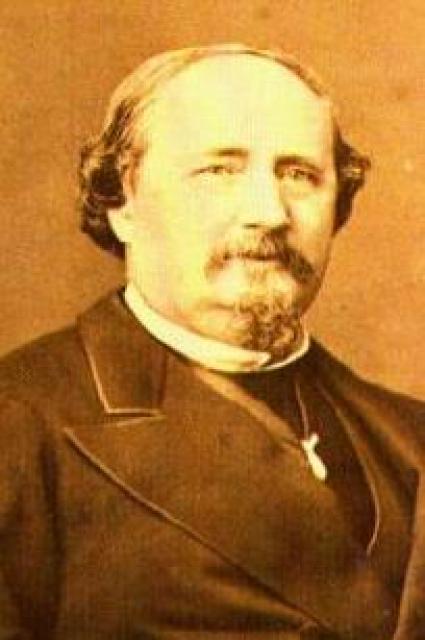
Emilio Arrieta
 Spain
Spain- Early Life and Education
- Milan Conservatory and Early Career
- Royal Composer and Madrid Conservatory
- Conservative Composer and Educator
- Collaboration and Critical Reception
- Later Years and Legacy
Early Life and Education
Emilio Arrieta y Corera was born into a family of landowners in Puente la Reina, Navarra, Spain. At the age of ten, he was sent to Madrid to live with his sister, who recognized his musical talent. In Madrid, Arrieta began studying solfège and quickly demonstrated his exceptional abilities.
Milan Conservatory and Early Career
After several trips to Italy, Arrieta enrolled in the Milan Conservatory from 1841 to 1845. There, he studied under renowned teachers, including the legendary Nicola Vaccai. During his time at the conservatory, Arrieta befriended fellow composer Amilcare Ponchielli, the future author of "La Gioconda." Upon graduating with the highest honors, Arrieta composed his first successful opera, "Ildegonda," which premiered in several Italian cities.
Royal Composer and Madrid Conservatory
In 1847, Arrieta returned to Madrid and quickly became a favorite of Queen Isabella II. Her patronage propelled his career forward, and within two months of "Ildegonda"'s premiere at the Teatro Real, Arrieta was appointed its principal composer. In 1850, he released another successful opera, "La conquista de Granada," based on a libretto by Temistocle Solera.
Conservative Composer and Educator
Throughout his life, Arrieta remained politically conservative and musically patriotic. While he did not actively participate in the founding of the Teatro de la Zarzuela, he composed "El sonámbulo" for the theater and collaborated on various other projects. Despite his conservative leanings, Arrieta wrote numerous zarzuelas and maintained a close friendship with Adelardo López de Ayala, a leading opponent of the "national music" movement.
Collaboration and Critical Reception
Arrieta frequently worked with prominent librettists, notably Antonio García Gutiérrez, the author of "El trovador" and "El grumete." While not all of Arrieta's works were universally acclaimed, his three-act opera "Marina" remains a testament to his musical style, characterized by its elegance and lyrical beauty.
Later Years and Legacy
In 1892, Arrieta suffered a stroke. Two years later, he passed away peacefully in his Madrid home. Despite occasional setbacks, Arrieta's legacy as a composer and educator lives on. His operas, particularly "Marina," continue to be enjoyed by audiences worldwide.



