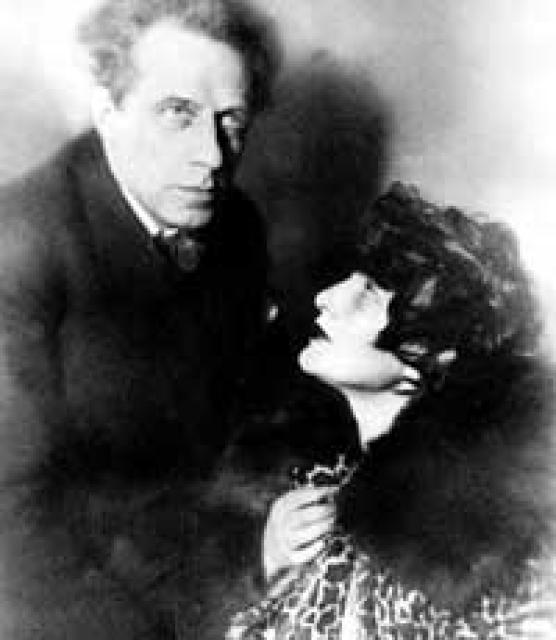
Esenin - Raih - Meirhold
 Russia
Zinaida Reich was a Russian and Soviet stage actress whose career became closely tied to the innovative director Vsevolod Meyerhold. Her life is also remembered through her earlier marriage to poet Sergei Yesenin, but Reich built her own reputation as one of the leading performers of Meyerhold’s Moscow theatre.
Early life and meeting Yesenin
Reich was born in Odessa on 3 July 1894. As a young woman, she worked in journalism and public service, and in 1917 she met Yesenin while working at the newspaper “Delo Naroda.” They married that summer and had two children, Tatyana and Konstantin.
The marriage soon became strained. Reich and Yesenin separated, and their divorce was formalized in 1921. Their relationship has often been retold as a romantic triangle with Meyerhold, but the more consequential shift in Reich’s life was her move toward theatre and an independent career.
The Meyerhold Theatre
Reich had met Meyerhold through her work in the People’s Commissariat for Education. She studied at his theatrical workshops and made her professional stage debut in 1924 as Aksyusha in Alexander Ostrovsky’s “The Forest,” in Meyerhold’s production.
She became a leading actress at the Meyerhold Theatre, earning recognition for roles that ranged from classical drama to modern Soviet plays. Her performances in “The Government Inspector” and “The Lady of the Camellias” helped establish her as a distinctive stage presence. She received the title of Honored Artist of the Russian Soviet Federative Socialist Republic.
Reich and Meyerhold married in 1922. He adopted her children and raised them as his own. Their artistic partnership and family life developed as Meyerhold’s experimental theatre faced growing criticism and political pressure.
Repression and murder
Authorities closed the Meyerhold Theatre in 1938. Meyerhold was arrested in June 1939. On the night of 14–15 July, Reich was murdered in her Moscow apartment. The killing came while her husband was in custody, and its circumstances have remained a subject of serious historical suspicion.
Reich’s death received little public notice at the time. Meyerhold was later executed in 1940, during the Stalinist purges.
Legacy
Zinaida Reich’s story is often framed through her marriages to two celebrated men, yet her theatrical work stands on its own. She was a central performer in one of the most influential experimental theatres of the Soviet era. Her career, alongside its abrupt and violent end, reflects the artistic innovation and political danger of the 1930s.