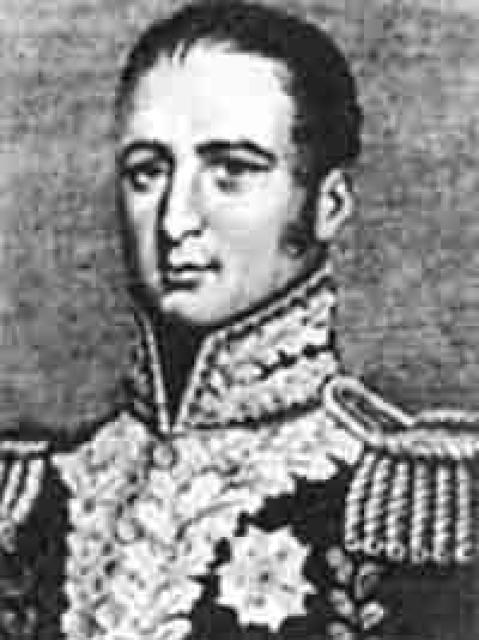
Etien Jerar
 France
Biography of Etienne Gerard
Etienne Gerard was a French military officer who held various titles, including Count, Baron, and Divisional General. He was born on October 11, 1791, the son of Prevost Damvilliers. At a young age, Gerard joined the military as a volunteer in the 2nd battalion of Meuse on October 11, 1791, and later transferred to the Grenadier company on October 11, 1792.
Gerard distinguished himself in the Battle of Jemappes and was promoted to sub-lieutenant on December 21, 1792. He gained further recognition in 1794 for his role in organizing a crossing over the River Rar. From April 4, 1794, he served as the aide-de-camp to General J. Bernadotte in the Northern Army. Gerard fought with success in battles at Fleurus and Charleroi and continued to serve in the Sambre-Meuse Army from 1794 to 1796.
On April 28, 1795, Bernadotte transferred Gerard to his staff, and he accompanied his patron to Italy and the Rhine. In 1799, Gerard was part of the Helvetic Army. On July 13, 1799, Bernadotte appointed him as the commander of the 9th Hussar Regiment. However, their relationship suffered after 1800, leading to a period of setbacks for Gerard. In March 1804, Bernadotte called Gerard back to his side, and from August 20, 1805, he served as Bernadotte's 1st aide-de-camp.
Gerard was wounded in the Battle of Austerlitz and participated in battles at Schleiz, Galle, Strelitz, Krivitz, and Lubeck. On November 13, 1806, he was promoted to brigade general and became the commander of a brigade in General Desjardin's division from December 31, 1806. He fought in the battles of Morungen and Preussisch Eylau. From March 15, 1807, Gerard commanded the 2nd brigade of the 3rd division of the 1st Corps.
On August 23, he took charge of the General Staff of Bernadotte's corps and was involved in the operations around Copenhagen on August 3, 1807. Gerard continued his military career, fighting in campaigns in 1809 at Durfour and Enzersdorf. He distinguished himself at the head of the Saxon cavalry in Bernadotte's corps during the Battle of Wagram on July 6, 1809. From October 30, 1809, he commanded the 1st brigade of the 1st division of the 2nd Corps.
In July 1810, Gerard was relieved of his post and sent to Spain, where he fought in the corps of General Drouet d'Erlon and under the command of General Claparede. He participated in battles at Fuente de Onoro and Valladolid. On August 15, 1811, he was recalled to France. From March 14, 1812, Gerard commanded a brigade in the 3rd division of General Gudden in the 1st Corps of the Grande Armée. He displayed exceptional bravery in the Battle of Smolensk and took command of the division after General Gudden's death on August 19.
During the Battle of Borodino, Gerard led his troops in an attack on the Kurgan heights. He distinguished himself in battles at Maloyaroslavets and Berezina. During the retreat of the Grande Armée, he commanded the rearguard of Davout's corps. In January 1813, he led the rearguard of Eugene de Beauharnais' troops. From March 7, 1813, Gerard became the commander of the 31st (later the 35th) Infantry Division of Marshal MacDonald's 11th Corps.
He participated in the battles of Lützen and Bautzen, where he was wounded on May 25 at Lauban. On August 23, Gerard replaced MacDonald as the commander of the corps. He distinguished himself at Goldberg, was wounded at Katzbach, and severely injured in the Battle of Nations at Leipzig on October 18, 1813. Due to his injuries, he left the army and arrived in Paris on November 2.
On December 29, he was appointed as the commander of reserves in Paris, overseeing the divisions of General Ricard and Dufour. In January 1814, his units became part of the 2nd Corps. In 1814, Gerard repelled the attacking forces of General M.I. Platov at the Battle of Méry-sur-Seine. He distinguished himself in battles at Brienne, La Rothière, Nogent, and Montreau. On February 18, Napoleon ordered Gerard to take command of Marshal Victor's 2nd Corps, which was in disarray. He conducted a series of successful operations before becoming a supporter of Napoleon's abdication.
On May 12, 1814, Gerard went to Hamburg as Count d'Artois. He received honors from the Bourbons and was appointed as the Inspector General of Infantry for the 5th Military District from February 25, 1852. In January 1827, he was elected as a member of the Chamber of Deputies and joined the opposition. Gerard played an active role in the July Revolution of 1830 and was appointed as Minister of War on August 11. On August 17, he was granted the title of Marshal of France.
On August 4, 1831, Gerard led the "Invasion Army" that successfully defended Belgium against the Dutch army. In 1832, he forced the surrender of the Dutch army in Antwerp. From February 11, 1833, he became a Peer of France. From July 18 to October 19, 1834, Gerard served as Minister of War and briefly served as Prime Minister in the same year. He was appointed as the Grand Chancellor of the Legion of Honor from February 4, 1836, to December 11, 1838, and from October 21, 1842, to February 25, 1848.
From December 11, 1842, Gerard became the Commander-in-Chief of the National Guard. On January 26, 1852, he became a Senator. During the "Hundred Days" of Napoleon's return, Gerard sided with the emperor and was appointed as the Commander of the 4th Observation Corps in Moselle, overseeing the 3rd and 4th military districts. From June 2, 1815, he became a Peer of France. In June 1815, Gerard commanded the 4th Corps in the Army of Belgium. On June 15, he began to move towards the bridges at Châtillon, but the situation became complicated when his divisional commander, General Burmon, fled to the enemy. He fought successfully at Ligny and his corps later joined Marshal Grouchy's group of troops.
During the Battle of Waterloo on June 18, 1815, Gerard unsuccessfully tried to convince Grouchy to change direction and go towards Waterloo, where artillery fire could be heard. On the same day, he was seriously wounded in the battle at Wavre. After the Second Restoration on August 12, 1815, Gerard went into exile in Belgium. In 1817, he returned to Paris, and on December 30, 1818, he was retired from active service. In January 1827, he was elected as a member of the Chamber of Deputies and joined the opposition. Gerard played an active role in the July Revolution of 1830 and was appointed as Minister of War on August 11. On August 17, he was granted the title of Marshal of France.




