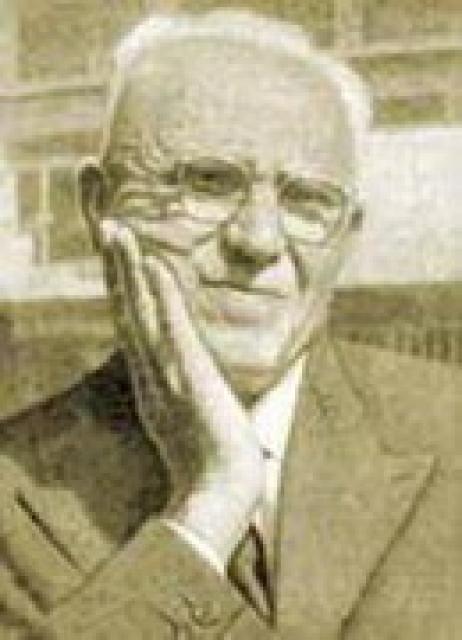
Evgen Nevan
 Czech
CzechBiography of Eugen Nevan
Eugen Nevan (1914-1967) was a prominent member of the "Generation 1909," a large group of Czechoslovak artists who laid the foundations of modern art in the country. The main characteristic of this artistic movement, which emerged during World War I, was the adherence to the traditions of French Impressionism and Post-Impressionism. The art of Cezanne, Renoir, Derain, and Matisse served as the primary artistic and ideological background for Nevan and his peers.
Nevan spent his childhood and youth in Liptovský Mikuláš, a major Slovak industrial center. As a high school student, he developed a passion for drawing, experimented with oil painting, and had a keen interest in art history. His favorite artists were Paul Cezanne and the German expressionist Georg Grosz. From an early age, Nevan had a good understanding of the visual arts, never missing any of the art journals that were available in Mikuláš.
After completing high school, Nevan moved to Prague, where he enrolled in the Faculty of Medicine at Charles University, following his family's decision. During his two years of study at the university, he immersed himself in the cultural life of the capital city, regularly visiting art galleries, exhibitions, and libraries, which broadened his horizons. It was during this time that he made the final decision to abandon his chosen profession as a doctor and instead pursue a career in art. Nevan was accepted into the Academy of Fine Arts in Prague.
From 1936 to 1939, Nevan studied under the guidance of professor Willy Nowak. In 1937, the aspiring artist visited Paris for the first time, coinciding with the World Exhibition taking place. The vibrant and direct experience of the latest achievements in French and international art, previously known to him mainly through reproductions, had a profound impact on Nevan. At this time, his interest shifted from Derain's somber palette to the life-affirming decorativeness of Matisse. Following Matisse, Nevan turned to the theme of the interior, incorporating female figures. One of his early works, "The Reading Girl by the Window" (1937, Slovak National Gallery, Bratislava), directly reflects the influence of the renowned French master. Throughout his career, the female figure, often depicted nude and surrounded by everyday surroundings, remained a central motif in Nevan's paintings.
The final year of Nevan's studies at the Academy was marked by the tragic events of European history. In the autumn of 1938, the infamous Munich Agreement led to the partition of Czechoslovakia into two puppet states: the Protectorate of Bohemia and Moravia and the clerical-fascist Slovak State. Like most of his Slovak classmates, Nevan was forced to remain in Prague. The horrors of war, the deaths of millions of people, and the deportation of civilians to concentration camps (from which the artist narrowly escaped by sheer luck) deeply affected him. One researcher of Nevan's work notes that his paintings, created during the war years, reveal a "cry of tragedy." In 1943, Nevan created the painting "Lidice," expressing his civil protest against the barbaric destruction of a Czech village by the Nazis after their failed assassination attempt on the Reich Protector of Bohemia and Moravia. The expressionistically interpreted scene of devastation, with a crucified figure in the foreground on the left and two mourning figures on the right, is executed in green-brown hues. Similarly dramatic and expressive are his other compositions from the wartime period, such as "Jacob's Dream" (1942), "The Murdered One" (1943), and "Still Life on the Theme of War. Still Life with a Map and a Skull" (1944).
In 1945, the artist returned to his homeland, Slovakia. The darkened palette of the painter, who had shifted his focus from personal experiences to the theme of universal tragedy, began to brighten again, becoming joyful and major. The heroines of his post-war paintings were primarily women, especially ballerinas. Nevan's interest in the world of dance was greatly influenced by his wife, who was a ballerina. He studied ballet intensively, eventually becoming a member of a professional ballet jury. His paintings, such as "In the Dressing Room," "Resting Ballerinas," and "Spring Noon," with their purely decorative solutions and a sense of monumentality, exuded a feeling of joy in existence. Nevan, who always sought to organically combine drawing and color modeling, became increasingly fascinated with graphic art from the late 1940s. In techniques such as drawing, lithography, monotype, and drypoint, he continued to develop his favorite motif of the female nude. In the early 1950s, the artist became interested in the ornamental nature of traditional Slovak costumes. Folk motifs became a new impetus for creating interesting compositional and coloristic solutions in his paintings and graphics.
Eugen Nevan, whose active artistic and public activities were interrupted by a serious illness in the late 1950s, brought the traditions of Post-Impressionism and, particularly, Fauvism to Slovak art. His paintings and graphic works always exhibited a "nearly classical harmony, lyrical elegance, and contemplation of human beauty."


