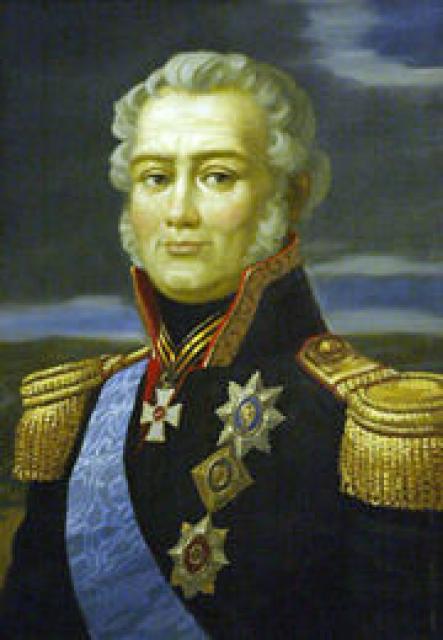
Fedor Buxhoevden
 Estonia
- Early Life and Military Career
- Rise through the Ranks
- Campaign in Poland and Governance in Warsaw
- Military Governor of St. Petersburg
- Disgrace and Restoration
- Campaigns in the Napoleonic Wars
- Commander in the Russo-Swedish War
- Legacy
Early Life and Military Career
Born into a noble Baltic family, Friedrich Wilhelm von Buxhoeveden (1750-1811) demonstrated exceptional military prowess from an early age. After graduating from the elite Artillery and Engineering Cadet Corps, he participated in the Russo-Turkish War (1768-1774), earning distinction at the Battle of Bender (1770) and receiving the Order of St. George (4th degree). His courage in the assault on Brailov (1771), where he captured two enemy cannons despite being wounded, further cemented his reputation.
Rise through the Ranks
Buxhoeveden's skills and achievements quickly propelled him up the ranks. In 1772, he became an adjutant to Count Grigory Orlov, the influential artillery chief and favorite of Catherine II. He commanded the Kexholm Life Guard Regiment in the Russo-Swedish War (1788-1790), distinguishing himself in the landing operation on the island of Kotka. For his leadership, he received the Order of St. George (3rd degree) and a promotion to major general.
Campaign in Poland and Governance in Warsaw
During the Polish Campaign (1793-1794), Buxhoeveden commanded an infantry division under the legendary General Alexander Suvorov. He played a key role in the capture of Warsaw, earning the Order of St. Vladimir (2nd degree) and the Golden Sword. From 1794 to 1796, he served as commandant of Warsaw and governor of Poland.
Military Governor of St. Petersburg
In 1797, Buxhoeveden was appointed military governor of St. Petersburg. During his tenure, he established the Auxiliary Bank for the Nobility, founded the Medico-Surgical Academy and the Midwifery Institute, and initiated the construction of the Rumyantsev Obelisk. He also declared the St. Andrew's Cathedral a "cavalry cathedral."
Disgrace and Restoration
As a staunch supporter of Suvorov's military tactics, Buxhoeveden faced Emperor Paul I's wrath and was dismissed from service in 1799. However, he was reinstated in 1803 as inspector of troops for the Livonian Inspection and governor-general of Riga.
Campaigns in the Napoleonic Wars
In 1805, Buxhoeveden commanded the Volyn Army in the Russo-Austro-French War, reinforcing Mikhail Kutuzov's army. He fought with distinction at the Battle of Austerlitz. In the Russo-Prussian-French War (1806-1807), he led an infantry corps before returning to his post as governor-general of Riga.
Commander in the Russo-Swedish War
During the Russo-Swedish War (1808-1809), Buxhoeveden became commander-in-chief of the Finnish army. He orchestrated the capture of the strategic fortress of Sveaborg, earning the Order of St. George (2nd degree). However, his success was short-lived, as Emperor Alexander I rejected his armistice proposal, leading to his resignation in December 1808.
Legacy
Friedrich Wilhelm von Buxhoeveden's military legacy is marked by his strategic thinking, ability to execute bold maneuvers, and resolute leadership. Despite his occasional differences with the emperor, Buxhoeveden remained a respected and distinguished general known for his unwavering loyalty to his troops.