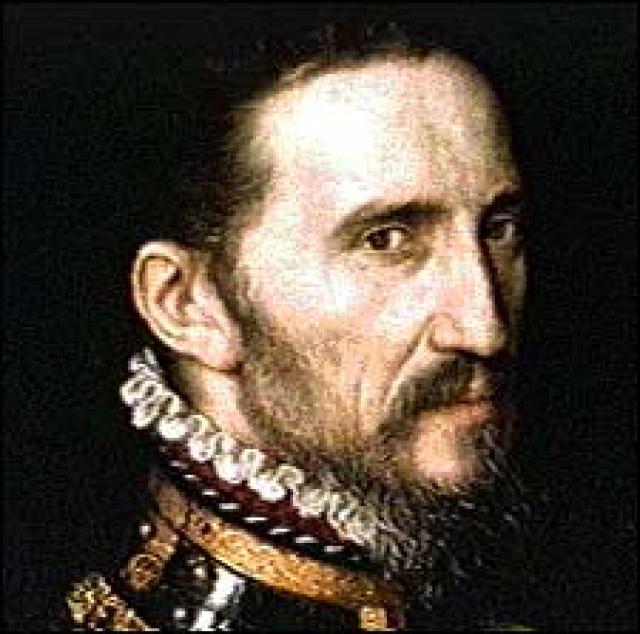
Ferdinand Alba
 Spain
Spain- Biography of Ferdinand Alba
- Early Life and Military Career
- Rule in the Netherlands
- Later Years and Death
Biography of Ferdinand Alba
Ferdinand Alba, Duke (1508-1582), was a Spanish military commander and statesman. He was sent by the Spanish king Philip II to the Netherlands to suppress the uprising against Spanish rule and the Catholic Church. Known for his extreme religious fanaticism and national intolerance, Alba brutally crushed the rebellion, which further fueled the anger of the population and led to Philip II recalling him from the Netherlands.
Early Life and Military Career
Alba's father was killed in a war against the Moors, and he was raised by his grandfather, the Duke of Toledo. Due to his character, which combined ruthless cruelty with a devout loyalty to his king and monarchy, he quickly became one of the most feared and renowned military leaders in Europe. At just 16 years old, he fought against the French and participated in all of Emperor Charles V's campaigns in France, Italy, Africa, Hungary, and Germany. In German history, his name is closely associated with the Battle of Mühlberg in 1547, where his decisive cavalry attack tilted the victory in favor of the Spanish army. He was less successful in the war for Metz in 1552, but he again commanded troops successfully in 1557 against Pope Paul IV's army, forcing him to abandon his alliance with France and once again support Spanish policies.
Rule in the Netherlands
Alba's most lasting, albeit also the bloodiest, legacy was his governorship in the Netherlands (1567-1573). When he arrived in the country from Spain with a small but elite force to strengthen Catholicism and King Philip II's monarchy, the revolution that had begun in the Netherlands in 1566 was already nearing its end. Alba's tyranny reignited the rebellion, costing Spain vast amounts of gold and blood, and ultimately resulted in the loss of two of Spain's richest provinces. Alba arrived with instructions from Philip II, which ordered the execution of prominent citizens, confiscation of their property, and the strict enforcement of Catholicism. The deaths of Prince Orange, Egmont, Horn, and others were predetermined. However, out of the three leaders, Alba only succeeded in capturing Egmont and Horn and arrested them on September 9, 1567. The court responsible for maintaining Spanish rule and named the "Council of Troubles" by the people gained a reputation for its ruthless and brutal actions under the cynical and crude leadership of Vargas. Over the course of three months, Alba sent up to 1,800 people to the gallows. Anyone suspected, even of enemy accusations, was already considered guilty, and the court only sentenced to death or confiscated property. The Orange princes, William and Ludwig, were also summoned to stand trial but did not appear. Instead, they started a war from Germany in the spring of 1568. Initially, they only worsened the already terrible situation in their country. Ludwig's victory in April 1568 prompted Alba to execute Egmont, Horn, and other nobles in June. He retaliated for Ludwig's victory with two victories of his own and skillful operations against William, completely ousting him from the country in October 1568. Then, a bloody purge began again in the Netherlands, with the number of executions soon reaching several thousand, property confiscated amounting to 30 million talers, and trade and industry coming to a halt, forcing hundreds of thousands of people to flee abroad.
Later Years and Death
After a year of bloody reprisals and fruitless victories, Alba lost hope of achieving his goals and requested to be relieved of his duty on December 18, 1573. He returned to Spain. Here he served his king once again by conquering Portugal in 1580. However, in his final years, he began to lose the trust of his monarch. This was not surprising, as Alba was not an unquestioning servant of the despot. On the contrary, in his dealings with Philip II, he acted like an aristocrat asserting his rights to power and prestige. When asked, in the presence of the king, about the possibility of conquering Portugal, he audaciously remarked, "And where then will our children seek refuge from the king?" According to the observations of Ranke, he had an aristocratic inclination to support despotism as long as it did not touch him personally. He did not long survive his last triumph; he died on January 12, 1582, in Tomar.


