Franz Conrad
 Austria
Biography of Franz Conrad
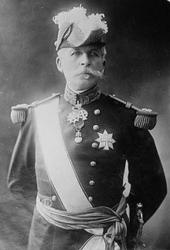
Franz Conrad was an Austro-Hungarian General Field Marshal (1916) and Count (1918). He was closely associated with the heir to the throne, Archduke Franz Ferdinand, and upon his recommendation, Conrad was appointed Chief of the General Staff in November 1906. He reorganized the army and strengthened the artillery. Conrad, as the leader of the so-called "military party," advocated for a preemptive war with Serbia and the annexation of Serbia, Montenegro, and Albania.
Early Life and Education
Franz Conrad hailed from an aristocratic family in southern Moravia. His great-grandfather was ennobled in 1816, adding his wife's maiden name, Conrad, to their family name, which originated from the Palatinate family von Goetsendorf. He was the son of a hussar colonel and the daughter of a well-known Viennese actress, Kubler. Conrad received his education at the Heuberg Cadet Corps (August 28, 1871) and the Academy of the General Staff (1876). He was commissioned into the 11th Jäger Battalion and participated in military operations in Bosnia and Herzegovina in 1878, 1879, and 1882, serving in the occupation forces until 1883.
Military Career
Conrad became the Chief of Staff of an infantry division in 1883. Most of his service was spent in the General Staff, and from 1888-1892, he served as a tactics instructor at the Academy of the General Staff. From 1895 to 1899, he commanded the 1st Infantry Regiment, and in 1899, he was appointed commander of an infantry brigade in Trieste. In 1903, he became the commander of an infantry division in Innsbruck. On November 18, 1906, with the support of Archduke Franz Ferdinand, Conrad was appointed Chief of the General Staff. He initiated an extremely active tenure, which led to his involvement in both domestic and foreign policies of Austria-Hungary. However, the parliament was reluctant to allocate funds for the army, which significantly lagged behind other countries' armies, particularly in terms of technology. Conrad reorganized the army and greatly strengthened the artillery.
As the head of the so-called "military party," Conrad advocated for a preemptive war against Serbia and the occupation of Serbia, Montenegro, and Albania. Additionally, he distrusted the alliance with Italy and sought to take decisive measures to secure the Austro-Italian border. Due to serious differences with the Foreign Minister, A. von Aehrenthal, Conrad was forced to leave his position as Chief of the General Staff in November 1911 and was appointed Army Inspector. However, on December 26, 1912, he returned to his former post. He was one of the main proponents of using the assassination of Franz Ferdinand as a pretext for starting military actions against Serbia and actively supported the idea of starting a war.
World War I
With the declaration of mobilization in August 1914, Conrad was appointed Chief of the General Staff of the Field Army under the Supreme Commander, Archduke Friedrich. He effectively controlled the Austro-Hungarian army. According to the initial plan, the war against the Russian Empire was supposed to begin with Austro-Hungarian troops advancing from Galicia towards the Lublin-Holm line, and simultaneously, German forces, numbering at least 15 divisions (including 10 in the front line), advancing from East Prussia towards Sedlec. Although Conrad actually had only three armies (1st, 3rd, and 4th) under his command since the rest, under the command of O. Potiorek, were sent to the Balkan front, he immediately launched a vigorous offensive towards Lublin and Holm, initially achieving great success. However, the anticipated German offensive towards Sedlec never materialized, even after the rout of the 2nd Russian Army under General A. V. Samsonov. As a result, the Austro-Hungarian forces, overwhelmed by the numerical superiority of the Russian forces, suffered heavy losses during the Battle of Galicia and were forced to retreat west of the Vistula River. Conrad considered the behavior of the German forces a betrayal and from that moment on, he harbored "evil feelings" towards them. This sentiment was further intensified by his desire to maintain maximum autonomy and protect the sovereignty of the Habsburg monarchy.
In early 1915, Conrad conceived a plan to launch an offensive from Tyrol into the rear of the Italian forces at the Isonzo, for which he requested support from General E. von Falkenhayn with eight German divisions. However, Falkenhayn did not find it possible to fulfill Conrad's request. Consequently, Conrad transferred some of his troops from the Austro-Russian front to carry out the planned operation. On October 19, 1915, Conrad married Virginia von Reininghaus, which caused a scandal in society because his wife refused to convert from Calvinism to Catholicism.
The offensive from Tyrol between the Adige and Brenta rivers in May 1916 initially progressed successfully but was eventually halted due to the weakened Austro-Hungarian front in Russia, which was attacked by General A. A. Brusilov's forces. Only with significant German reinforcements and troops redeployed from the Italian front was the Russian offensive barely repelled. Shortly after Archduke Friedrich's departure from the Supreme Command, replaced by Emperor Karl I, Conrad was removed from his post on March 1, 1917, and appointed commander of the 11th Army in South Tyrol. In effect, Conrad assumed command of all Austro-Hungarian forces on the Tyrolean front. During the Battle of Caporetto (October-November 1917), which ended in the defeat of Italian forces, Conrad operated along the Brenta River, flanking the main Italian forces. His army captured Asiago, Teglio, and Belluno but failed to seize the last mountain positions on Monte Grappa, which guarded the entrance to the plain. Conrad also participated in the general offensive of the Austro-Hungarian army on the Italian front in June 1918, which was unsuccessful due to the army's increasing disintegration. On July 15, 1918, Conrad was relieved of command and appointed Chief of the Imperial Convoy, Colonel of the Leib-Guard, and Chancellor of the Military Order of Maria Theresa.
After the war, Conrad served as the honorary president of the Association "Alt-Neustadt," an organization of graduates from the Vienna-Neustadt Military Academy. He authored memoirs titled "From My Service, 1906-1918" (volumes 1-5, 1921-25) and "The Beginnings of Life: Military Service in 1878-1882" (1925).