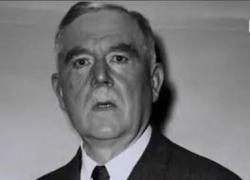
Friedrich Jeckeln
 Germany
Biography of Friedrich Eckle
Friedrich Eckle was born in October 1941 in Riga, Latvia, and soon became the new owner of Ostland. Despite his unassuming appearance, with his average height, slender build, and pleasant facial features, Eckle wore the striking black uniform adorned with oak leaves and SS runes on his collar. At the age of 46, he held the rank of Obergruppenführer SS, one of the highest-ranking administrators in the Reich.
Rise to Power
Eckle never made a wrong choice when it came to his career. From the beginning, he firmly aligned himself with Hitler and preferred to be the executioner rather than the one executed. He had an animal instinct for survival. Joining the NSDAP and quickly advancing in the party, he realized that being a low-ranking party official meant nothing, while the real power lay in controlling the SS forces. In 1933, when Adolf Hitler became Chancellor, out of the 50,000 SS men trained throughout Germany, seven thousand elite party fighters answered to Eckle. He became the leader of the SS group in the South, which included SS units in Munich, Bavaria, Württemberg, and Baden.
Eckle stood shoulder to shoulder with the party leaders and solidified his position in the NSDAP after Hitler eliminated his rivals within the party in June 1934. After Hitler's victory, he hosted a banquet for his closest and most trusted comrades, including Eckle. Eckle's career reached its peak during the war, where his talents as an organizer and leader fully blossomed. He spent some time working in occupied France, and when the great battle on the Eastern Front began, Hitler appointed him as the top commander of the SS and Police forces in Army Group South, operating in Ukraine.
Role and Actions
As an Obergruppenführer, Eckle was responsible for organizing the global terror campaign unleashed on the occupied territories. He oversaw Jewish pogroms, mass killings, and anti-partisan operations that resulted in the destruction of entire regions. Eckle was behind the horrific massacres of Jews in Lviv, the terrifying Jewish pogrom in Berdychiv, and the shootings of Jews in the Babi Yar ravine in Kyiv. He also ordered the sterilization of hundreds of women in mixed marriages with Jews.
In the fall of 1941, Eckle was appointed as the Chief of SS and Police forces in Ostland. Before leaving for his new post, he had an audience with Reichsführer Himmler, who gave him clear instructions. Eckle was to ensure complete peace throughout the Baltic region, exterminate all remaining Jews in Ostland, and colonize the territory after the final victory of the Reich. The local population who proved their loyalty to the German Empire would be allowed to stay and Germanize, while others would be expelled to the Reich for hard labor. The freed territories would be settled by German colonists, and Riga became the capital of the region.
Upon arriving in Riga, Eckle carefully analyzed the situation. He was dissatisfied with the slow progress in solving the Jewish question, and the Jewish ghetto in Riga appeared as an unpleasant sore to him. Eckle was frustrated by the sluggishness and disorganization of the Einsatzgruppen killers. The executions were carried out in a chaotic and uncoordinated manner. The drunkenness of the executioners during the shootings in Bikernieki Forest further prolonged the killings, leading to the absurdity of finishing off the wounded in mass graves.
However, Eckle's reputation as one of the boldest, most decisive, and influential military administrators in the Reich remained intact. He would fulfill Himmler's orders to the best of his abilities, especially after receiving a brilliant idea from the Reichsführer to carry out after the cleansing of the Riga ghetto.
The Final Solution
The preparation for the operation took a month, conducted in utmost secrecy, with Russian prisoners of war digging massive graves in the Rumbula Forest on the outskirts of Riga. All prisoners were immediately exterminated. On November 29 and December 8, 1941, the almost 30,000-strong Riga ghetto was completely annihilated.