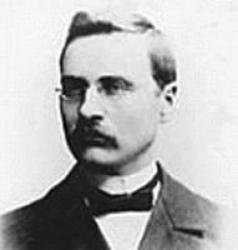
Friedrich Muller
 Germany
Biography of Friedrich Müller
Friedrich Müller was a German philologist, orientalist, and expert in general linguistics and mythology. He was the son of German writer, poet, and court librarian Wilhelm Müller. In 1841, Müller enrolled in Leipzig University, where he began studying Sanskrit on the advice of German publisher and scholar Hermann Brockhaus. In 1844, he studied comparative philology under the renowned professor Franz Bopp in Berlin, and also delved into the idealistic philosophy of Friedrich Schelling. During a visit to Paris in 1845, Müller acquainted himself with the works of Eugène Burnouf, a leading specialist in the language of the Avesta, which inspired him to study comparative religion. This discipline continued to captivate his attention throughout his life.
In 1846, Müller embarked on a journey to England with the aim of publishing a new edition of the "Rigveda." He studied the archives of the East India Company in London and worked at the Bodleian Library of the University of Oxford. The young German scholar was warmly received by English academics, who introduced him to Queen Victoria and Prince Consort, and convinced the East India Company to provide financial support for the publication of the "Rigveda" (6 volumes, 1849-1874). In 1856, Müller became a lecturer in modern languages at Taylor Institution in Oxford, where his reputation quickly grew thanks to his brilliant lectures on classical anthropology and linguistics.
Despite his lack of interest in the emerging fields of anthropology and ethnography, Müller asserted that the development of human consciousness should be explained through the history of language. He considered himself the "author of the science of language," although many of his theories were later disproven by subsequent research. Müller unwittingly became the originator of the popular "Aryan theory" that gained prominence from the second half of the 19th century. He introduced the term "Aryan" as a replacement for the unwieldy term "Indo-European." He was one of the first scholars to study the migration of Indo-European peoples, laying the groundwork for the pseudoscientific "Aryan theory" based on the manipulation of the concepts of "race" and "language."
Müller himself was surprised by the unexpected applications of his hypotheses and, in 1888, warned researchers studying race-related issues: "I repeatedly state that when I speak of 'Aryans,' I do not mean blood, bones, hair, or skulls. I only refer to those who speak the Aryan language. For me, an ethnologist who insists on an Aryan race, Aryan blood, Aryan eyes and hair, represents the greatest sin as a linguist who discusses a dolichocephalic vocabulary or a brachycephalic grammar. It is worse than the Babylonian confusion of languages; it is blatant theft. We must create our own terminology for classifying languages. Let ethnologists create their own terms for classifying skulls, hair, temperaments, origins, and races." Müller emphasized that the concept of "Aryan" in linguistics is completely irrelevant to origins. It signifies language and nothing but language. If someone speaks about the Aryan race as a whole, it means nothing beyond Aryan speech.
However, the damage had already been done. Müller acknowledged the criticism, but his arguments had no impact on racists. He passed away in Oxford on October 28, 1900. From that time onwards, the borrowing of "scientific" linguistic paleontology to support the existence, purity, and superiority of the Aryan (later Nordic) race began. Ultimately, racism became the central ideology of the Third Reich. This biography is based on the material from the Encyclopedia of the Third Reich.