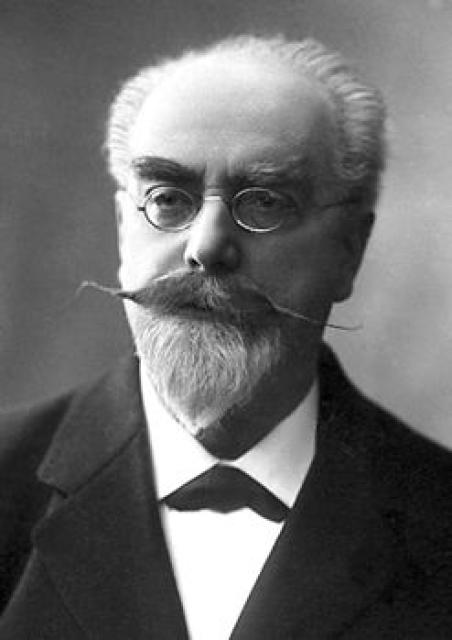
Gabriel Lipman
 Luxembourg
- Biography of Gabriel Lippmann
- Interest in Electricity and Research in Germany
- Scientific Career and Contributions
- Color Photography
- Later Contributions and Legacy
Biography of Gabriel Lippmann
Early Life and EducationGabriel Jonas Lippmann, a French physicist and Nobel laureate, was born in Hollerich, Luxembourg. He studied at home until the age of thirteen, and after his parents moved to Paris, he attended the Lycée Napoleon. In 1868, Lippmann became a student at the École Normale Supérieure.
Interest in Electricity and Research in Germany
Lippmann's interest in electricity began when he worked on translating German articles for the French journal "Annales de Chimie et de Physique." During a government-funded trip to Germany in 1873 to study teaching methods in natural sciences, Lippmann worked at Heidelberg University with physiologist Wilhelm Kühne and physicist Gustav Kirchhoff, and later in Berlin with physiologist and physicist Hermann von Helmholtz. It was during this time that Kühne showed Lippmann an experiment in which a drop of mercury, covered with sulfuric acid, deformed at a slight touch of an iron wire. Lippmann concluded that metals and sulfuric acid form an electric battery, and the voltage changes the shape of the mercury's surface. This fortunate discovery allowed him to create the capillary electrometer (or voltmeter) - an inclined glass capillary tube with sulfuric acid and a mercury column on its surface. The induced changes in the mercury's surface caused by electricity make the mercury column move in the capillary, allowing the measurement of electric potential differences up to 0.001 volts.
Scientific Career and Contributions
Upon returning to Paris, Lippmann completed his studies and conducted research on electrocapillarity and the effect of electric fields on the surface tension of liquids. In 1875, he defended his dissertation at Sorbonne University to obtain his doctorate. In 1878, Lippmann became a faculty member of the Faculty of Natural Sciences at the University of Paris, and in 1883, he was appointed as a professor of mathematical physics. From 1886, Lippmann served as the head of a research laboratory and continued his work there until the end of his life.
Lippmann conducted research on the effect of mechanical deformation on the surface of mercury, which was the opposite phenomenon to the one on which the capillary electrometer was based. This work helped Lippmann formulate a general theorem, which he published in 1881. This theorem states that knowing the existence of a certain physical phenomenon allows us to predict the existence and magnitude of the reverse effect. Lippmann applied his theorem to the phenomenon of piezoelectricity - the generation of electric charges when certain crystals, such as quartz, are compressed or stretched. As mechanical forces change the dimensions of the crystal (changes in dimensions lead to the appearance of voltage), Lippmann predicted that applying voltage to a crystal would cause a change in its dimensions. Pierre and Jacques Curie experimentally confirmed Lippmann's hypothesis.
The reverse piezoelectric effect is now widely used in science and technology. Applying alternating voltage to piezoelectric crystals forces them to vibrate and emit sound waves, which find applications in sonars (devices for detecting submarines), various ultrasound devices used for surface cleaning, remote control, and in dental drills.
Color Photography
In 1891, Lippmann demonstrated a method for obtaining non-fading color photographs. The process of obtaining color photographs was proposed in 1848 by French physicist Edmond Becquerel. It involved a silver plate coated with a layer of silver chloride, but the photographs quickly faded, and Becquerel could not explain the formation of a color image. Twenty years later, German physicist Wilhelm Zenker explained the color formation on Becquerel's photographs as an interference phenomenon. Zenker's theory further developed in the works of English physicist J.W. Strutt and was experimentally confirmed in 1890 by German physicist Otto Wiener.
Lippmann denied that the colors in photographs using Becquerel's method were due to interference. He claimed that interference was the basis of his own method. Lippmann's plates were made of transparent glass and coated with a relatively thick layer of light-sensitive emulsion made of gelatin, silver nitrate, and potassium bromide. During exposure, a cassette covered the free side of the glass plate with mercury, creating a shiny reflecting surface. Interference patterns between the light falling from the object and the light waves of the same length reflected from the mercury were captured in the distribution of silver grains formed during development. These metallic grains became copies of the interference patterns for different colors as darkened layers at different depths and with different lateral displacements. When such a photograph was viewed in normal light, i.e., a mixture of all colors, light was reflected from both the layers of metallic silver grains and the silver plate itself. The reflected light waves from layers of different depths were reinforced due to interference only at specific wavelengths (colors) corresponding to the distances between the layers, thus reproducing the colors of the photographed object.
For his invention of a method of reproducing colors in photography based on the interference phenomenon, Lippmann was awarded the Nobel Prize in Physics in 1908. In his Nobel lecture, he demonstrated that color indeed arises from interference in the photographic plate without the involvement of any dyes. Lippmann emphasized the need for further improvement of his method, as the exposure time (1 minute in sunlight) was still too long for portrait photography. He also noted the significance of photographic reproduction in modern life.
Later Contributions and Legacy
In the following years, Lippmann made significant contributions to seismology and astronomy. He proposed using telegraph signals for early earthquake warnings and measuring the speed of elastic waves in the Earth's crust. Lippmann developed a new type of seismograph for directly measuring the acceleration in the movement of the Earth's surface. He also designed two astronomical instruments: the holostat with a slowly rotating mirror, allowing for the capture of a stationary image of a section of the sky rather than just a single star, and the uranograph, which enabled the creation of a photographic map of the sky with pre-drawn meridians for convenient time measurement.
Lippmann's textbook on thermodynamics became a standard course in France. He was a member of the French Academy of Sciences (serving as its president in 1912) and a member of the Royal Society of London. Lippmann was honored with the rank of Commander of the Legion of Honour.
Lippmann married in 1888 and tragically passed away aboard the ship "La France" while returning from a trip to Canada.
Gabriel Lippmann's contributions to physics, color photography, and various other scientific fields left a lasting impact on the scientific community and continue to be recognized today.


