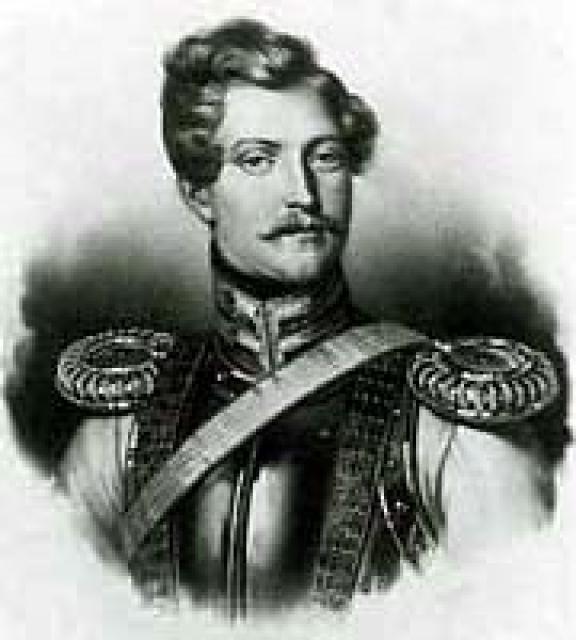
Georges D'Anthes
 France
- GEORGES-CHARLES DE HÉCKEREN D'ANTÈS: A BIOGRAPHY
- Military Career and Political Affiliations
- Marriage to Ekaterina Goncharova and the Pushkin Duel
- Return to Sulz and Later Life
- Legacy
GEORGES-CHARLES DE HÉCKEREN D'ANTÈS: A BIOGRAPHY
Early Life and Family HistoryGeorges-Charles de Héckeren d'Antès, born in Sulz, Alsace, France, in 1812, descended from a long line of aristocrats tracing their roots to the 18th century. His family's origins lay in the region of Alsace, annexed to France by Louis XIV.
His paternal line traced its roots to Jean-Henri Antès, who established himself in Sulz in 1720 and founded a royal manufactory for the production of cold weapons. The prosperity and prestige derived from this enterprise earned the family a noble title and the addition of "de" to their surname.
Military Career and Political Affiliations
Georges-Charles's family's loyalty to the Bourbon dynasty extended into his own time. As a young man, he joined the military academy at Saint-Cyr and became a supporter of the legitimist efforts to restore the Bourbon monarchy.
After the 1830 revolution overthrew King Charles X of Bourbon, Georges-Charles participated in a failed counterrevolutionary movement led by the Duchess of Berry. This affiliation forced him to flee France for Russia, where he was granted asylum by Tsar Nicholas I.
Marriage to Ekaterina Goncharova and the Pushkin Duel
In Russia, Georges-Charles met Ekaterina Goncharova, the sister of Alexander Pushkin's wife, Natalya. They were secretly married in 1836, a union that sparked controversy and gossip in Russian high society.
In response to perceived insults and in defense of his family's honor, Pushkin challenged Georges-Charles to a duel on January 27, 1837. The duel resulted in Pushkin's fatal injury and his death two days later.
Return to Sulz and Later Life
Following Pushkin's death, Georges-Charles was expelled from Russia and demoted to the rank of soldier. He returned to Sulz with his wife and adopted the surname de Héckeren, which he passed on to his descendants.
In 1870, Georges-Charles became mayor of Sulz, where he left a lasting mark on the town's architecture. He died in 1895, leaving behind a controversial legacy as the man who killed one of Russia's greatest poets.
Legacy
Georges-Charles de Héckeren d'Antès's life has been the subject of much speculation and debate. His relationship with Ekaterina Goncharova and his role in Pushkin's death have sparked numerous works of literature, music, and film adaptations.
His family, the de Héckeren-d'Antès, continues to reside in Sulz, where their ancestral home, the "Château d'Antès," stands as a reminder of their intertwined history with the town and the events surrounding Pushkin's death.