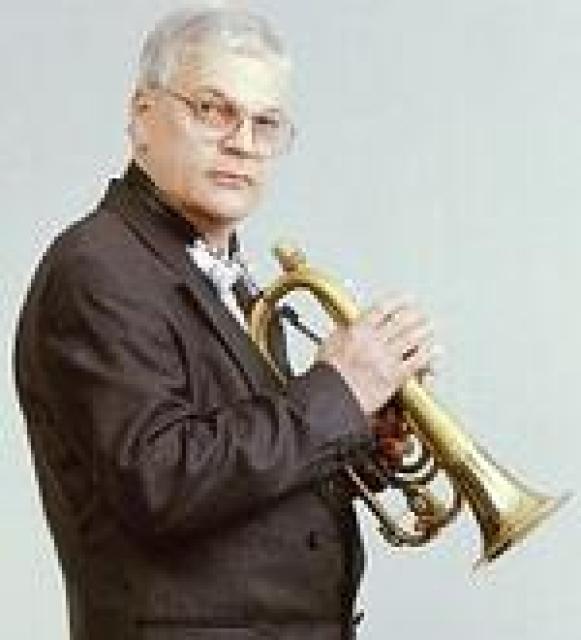
German Lukianov
- Birth and Musical Origins
- Musical Education and Early Influences
- Transition to Flugelhorn and Debut Recordings
- First Trio and International Recognition
- Evolution of Trios and Fusion of Russian Folk
- Expansion and Versatility
- "Kadans" Ensemble and Avant-Garde Experiments
- International Exposure and Discography
- Later Career and Poetic Explorations
Birth and Musical Origins
Herman Lukyanov, a towering figure in Russian jazz, was born on August 23, 1936, in Leningrad to a military seaman father. His mother, an accomplished pianist with a classical music education, also excelled as a poet and translator.
At the tender age of 12, Lukyanov's musical destiny was ignited by a transformative encounter with jazz recordings. A 78 rpm record featuring the orchestras of Alexander Tsfasman and Alexander Varlamov introduced him to the sounds of "Sounds of Jazz" and "Sweet Sue." These early musical experiences sowed the seeds of his lifelong passion for the genre.
Musical Education and Early Influences
In his adolescence, Lukyanov pursued his interest in jazz by enrolling in an evening music school, where he studied trumpet. Seeking further refinement, he later attended the Leningrad Conservatory, studying composition under Vadim Salmanov. In 1957, he transferred to the Moscow State Conservatory, where he completed his studies in composition with Aram Khachaturian in 1961.
Transition to Flugelhorn and Debut Recordings
By the early 1960s, Lukyanov had developed a reputation in Moscow's jazz scene as a highly skilled but unconventional musician. Rejecting the trumpet, he embraced the flugelhorn as his primary instrument, though he returned to the trumpet in 1989. One of his earliest recordings, released in 1960, featured his composition in an album by the septet of Boris Rychkov, Georgy Garanyan, and Andrei Zubov.
First Trio and International Recognition
In 1962, Lukyanov formed his first trio with Mikhail Terentyev (piano) and Alfred Grigorovich (contrabass). This unconventional ensemble, featuring a combination of flugelhorn, contrabass, and piano, defied conventions with its sparse textures, abundant pauses, and innovative use of space.
International acclaim followed when world-renowned jazz critic Leonard Feather, visiting the USSR with Benny Goodman's orchestra, described Lukyanov's music as "on the cutting edge of world jazz."
Evolution of Trios and Fusion of Russian Folk
In 1965, Lukyanov reorganized his trio to include Leonid Chizhik (piano) and Vladimir Vasilykov (drums). This new trio showcased Lukyanov's ability to incorporate Russian folk melodies and intonations into the modern jazz idiom. His approach to the trio, as he explained, aimed to achieve clarity and melodic purity, even at the expense of a more textured sound.
The trio's remarkable performance at the 3rd Moscow Jazz Festival in 1966 earned them five diplomas and recognition as the best ensemble featuring the best composer and performer.
Expansion and Versatility
Through the late 1960s and 1970s, Lukyanov's musical journey continued with the formation of various ensembles of varying sizes. He collaborated with the All-Union Radio Variety Orchestra under Vadim Lyudvikovsky and performed with the Czechoslovak Radio Jazz Orchestra.
"Kadans" Ensemble and Avant-Garde Experiments
In 1978, Lukyanov established the "Kadans" ensemble. Combining elements of chamber jazz and improvisational freedom, "Kadans" featured a diverse instrumentation that allowed for a wide range of timbres and expressive possibilities.
Lukaynov's compositions for "Kadans" displayed his mastery of complex rhythms, innovative arrangements, and unconventional harmonic techniques. The ensemble's sophisticated and challenging music pushed the boundaries of Soviet jazz during the 1970s and 1980s.
International Exposure and Discography
"Kadans" toured extensively throughout the USSR and gained international recognition at festivals such as Jazz Jamboree in Warsaw and North Sea Jazz Festival in The Hague. The ensemble released four critically acclaimed LPs on the Soviet record label "Melodiya," which were later reissued on CD in 1999.
Later Career and Poetic Explorations
In the 1990s, as economic conditions shifted, Lukyanov scaled down "Kadans" to a trio, later expanding it to a quartet. He continued to experiment with unconventional percussion instruments and collaborated with young musicians.
Beyond his musical endeavors, Lukyanov explored poetry, winning an award at the International Verlibre Festival. His free verse style defied traditional poetic conventions.


