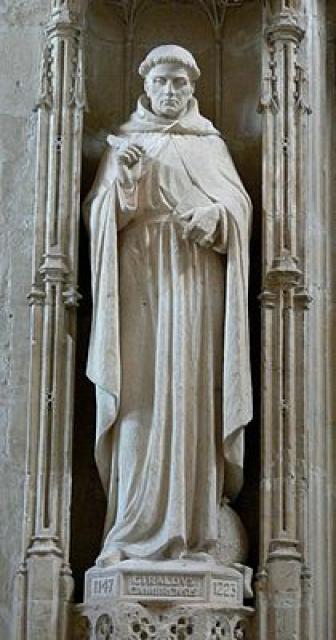
Giraldus Cambrensis
 Great Britain
Early Life and Education
Gerald of Wales was a prominent medieval British historian and church writer primarily associated with Wales. Born into a powerful Norman family, his father was William de Barri, a notable feudal lord in Wales. His maternal lineage traced back to Gerald of Windsor, his grandmother's brother and a prominent aristocrat.
Gerald received his ecclesiastical education at Gloucester and Paris, likely aspired for an ecclesiastical career. Unfortunately, he faced obstacles in succeeding his uncle as Bishop of St. Davids, possibly due to his Welsh ancestry.
Literary Endeavors
Despite not securing the coveted bishopric, Gerald accompanied King Henry's son, John, on his expedition to Ireland in 1184. This experience sparked his literary career, culminating in the publication of "Topographia Hibernica" (1188), a narrative of his Irish observations, and "Expugnatio Hibernica," chronicling the Norman conquest of Ireland.
In 1188, Gerald embarked on a journey through Wales with Baldwin, Archbishop of Canterbury, to recruit for the Third Crusade. This expedition provided the foundation for his two seminal works: "Itinerarium Cambriae" (1191), a travelogue, and "Descriptio Cambriae" (1194), a comprehensive description of Wales. Despite their biases and occasional inaccuracies, these accounts remain invaluable sources of information on Welsh and Norman culture and history.
Aspirations for the Episcopacy
Gerald's ambition for the Bishopric of St. Davids remained unfulfilled. He made three visits to Rome to lobby for the elevation of the diocese to an archbishopric, but Pope Innocent III resisted the division of the Welsh Church from Canterbury. Gerald believed political concerns contributed to his exclusion from the bishopric.
Later Career and Legacy
Undeterred by his ecclesiastical disappointments, Gerald dedicated himself to writing. He produced moral tracts, theological works, and political treatises. He passed away around 1223, likely in Lincoln. Gerald's extensive writings continue to provide historians with a rich understanding of medieval Wales and its complex relationship with the Norman conquerors.