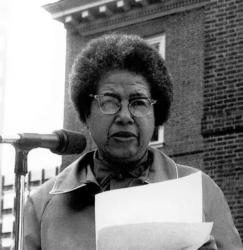
Gregoire Kayibanda
 Rwanda
- Early life and journalism
- Revolution and independence
- Presidency and violence
- Coup, imprisonment and death
Grégoire Kayibanda (May 1, 1924 – December 15, 1976) was a Rwandan politician, journalist and nationalist who became the first president of the independent Republic of Rwanda. He led the country from 1962 until a military coup in 1973. His political career helped end the monarchy and Belgian rule, but his government also entrenched ethnic divisions and presided over severe violence against Tutsi civilians.
Early life and journalism
Kayibanda was born in Tare, in the Gitarama area of what was then Ruanda-Urundi, a territory administered by Belgium. He studied at the Catholic seminary of Nyakibanda and later worked as a teacher and journalist. Catholic publications gave him a public platform: he edited the Kinyarwanda newspaper Kinyamateka and wrote on social and political questions at a time when senior positions in the colonial and royal administrations were dominated by Tutsi.
In 1957, Kayibanda joined eight other Hutu intellectuals in drafting the Bahutu Manifesto, a document that demanded greater political representation for the Hutu majority. It challenged the existing hierarchy but also framed Hutu and Tutsi as distinct racial groups and portrayed Tutsi political influence as a monopoly. That language helped shape political mobilization in the years that followed.
Revolution and independence
Kayibanda organized the Hutu Social Movement, which became the Party of the Hutu Emancipation Movement, known by its French acronym PARMEHUTU. During the 1959 revolution, violence and political upheaval brought down the Tutsi monarchy and drove many Tutsi into exile. Belgium shifted its support toward Hutu-led parties, and PARMEHUTU won a dominant position in the transition to self-government.
Kayibanda became prime minister in 1961 and president after Rwanda attained independence on July 1, 1962. The new republic replaced the monarchy and expanded the political participation of Hutu, who formed the great majority of the population. Kayibanda presented his rule as majority emancipation and national self-determination, though the government’s increasingly partisan policies narrowed the space for political opposition and helped turn ethnic identity into a basis for political power.
Presidency and violence
The first years of independence were marked by attacks and displacement. In December 1963, armed Tutsi exiles attempted to enter Rwanda from Burundi. Government forces repelled the incursion, after which the Kayibanda government unleashed or enabled reprisals against Tutsi civilians. Thousands were killed in the massacres of 1963–64, and many more fled the country. Historical accounts describe the state’s role as central: Kayibanda’s administration used the incursion to intensify anti-Tutsi terror, while opposition leaders were also executed.
PARMEHUTU dominated the political system, and Kayibanda was returned to office in elections held under its control. His government promoted Hutu political predominance and restricted Tutsi access to education and public employment. Political tensions also reflected regional rivalries within the ruling elite. The republic he led achieved independence and dismantled the old royal order, yet its exclusionary politics left deep grievances and a legacy of mass violence.
Coup, imprisonment and death
On July 5, 1973, Defense Minister Juvénal Habyarimana seized power in a military coup. The takeover itself was bloodless, but Kayibanda was arrested and confined under the new regime. He died in detention on December 15, 1976, aged 52. Accounts of his final years report that he was held in isolation and received inadequate food and medical care; the precise circumstances of his death were never independently established.
Kayibanda remains a consequential and controversial figure in Rwanda’s history. He was a leading voice in the movement that ended colonial rule and established the republic, but the ethnicized political order built during his presidency also brought persecution, massacres and the displacement of Tutsi. His rule is therefore remembered both as a turning point toward independence and as a formative period in the country’s later conflicts.