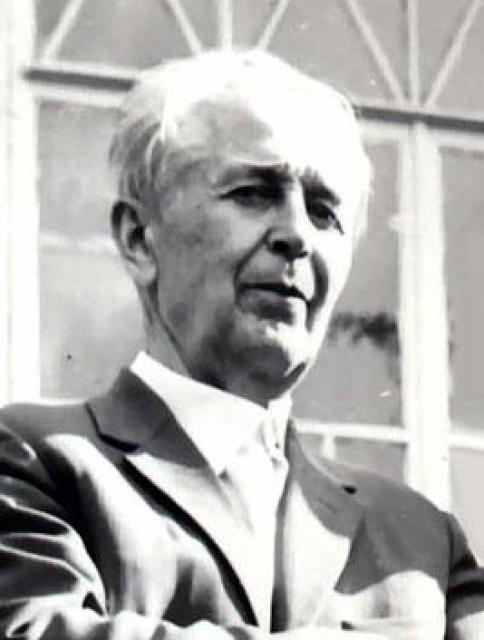
Grigoriy Kochur
 Ukraine
- Early Life and Education
- Teaching and Literary Career
- Imprisonment and Release
- "Irpin University" and Literary Leadership
- Political Activism
- Restoration and International Recognition
- Legacy
Early Life and Education
Hryhoriy Kochura was born on April 3, 1908, into a peasant family in the village of Zamostya in Ukraine. He completed his education at the Kyiv Institute of Public Education, where one of his teachers was the renowned poet Mykola Zerov.
Teaching and Literary Career
Following his graduation, Kochura taught at pedagogical institutes in Tiraspol and Vinnytsia. He began working on a doctoral dissertation on the work of the French poet Paul Verlaine, but the outbreak of World War II prevented him from completing it.
Imprisonment and Release
In 1943, Kochura was arrested along with his wife and sent to a labor camp in Inta, Russia. He was released in 1953 and rehabilitated in 1962.
"Irpin University" and Literary Leadership
Upon his release, Kochura settled in Irpin, a town near Kyiv. His house became a gathering place for Ukrainian intellectuals, earning it the nickname "Irpin University." Kochura emerged as an informal leader among Ukrainian translators. Among the frequent visitors to his home were Vyacheslav Chornovil, Ivan Dziuba, Lina Kostenko, and Vasyl Symonenko.
Political Activism
In 1968, Kochura was among the signatories of the "Letter of 139," a protest against the illegal political trials taking place in Ukraine. As a result of his activism, he was expelled from the Writers' Union of Ukraine in 1973 and barred from publishing for fifteen years.
Restoration and International Recognition
Kochura was reinstated into the Writers' Union in 1988. Between 1991 and 1992, he traveled abroad for the first time, attending conferences in the United States, Poland, and the Czech Republic.
Legacy
Kochura was a prolific translator, having translated works from over 26 centuries and three continents. He also wrote extensively on translation theory and Ukrainian literature. He received numerous awards for his contributions, including the M. Rylsky and T. Shevchenko Prizes for his translation work.
Kochura's legacy extends beyond his literary achievements. He is credited with playing a significant role in the Ukrainian dissident movement. His home in Irpin has been transformed into a museum, and a translation department at Lviv University has been named in his honor. In 2008, a postage stamp was issued to commemorate the 100th anniversary of his birth.


