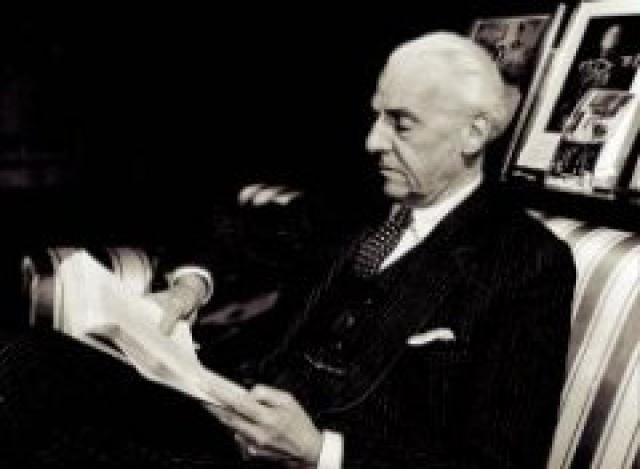
Guido Chigi Sarachini
 Italy
Guido Chigi Saracini used his family’s resources and his love of music to reshape the cultural life of Siena. An amateur composer and violin student, he became one of Italy’s most important musical patrons, creating concert opportunities for established artists and advanced training for young performers. The academy he founded in 1932 grew into an international institution that continues to carry his name.
A musical upbringing
Born in Siena on March 8, 1880, Guido Chigi Saracini came from a family with a long history of musical interests. He studied violin at the Luigi Cherubini Conservatory in Florence, but family responsibilities soon required him to oversee the family’s substantial estate. He did not abandon music: he continued composing songs and short piano pieces and devoted much of his life to supporting musicians and cultural institutions.
His patronage was not simply a matter of opening his home to concerts. Chigi Saracini wanted Siena to become a significant center of musical life, connected to the leading artists and ideas of Italy and Europe.
Concerts and cultural life in Siena
In 1908, he helped establish the Quintetto Senese, an ensemble for strings and piano. He supported its concerts financially, directing proceeds toward charitable organizations. The model combined musical activity with public service, a principle that remained part of his work as a patron.
After the First World War, in which he served as a volunteer driver, he began transforming the family’s Palazzo Chigi Saracini into a setting suited to concerts and musical study. The palace’s concert hall opened in 1923, alongside the winter concert series Micat in Vertice. The program soon brought leading performers to Siena and helped establish the city’s musical reputation.
In 1928, he hosted the sixth festival of the International Society for Contemporary Music. The event introduced Siena audiences to works by composers including Prokofiev, Ravel, Webern, Hindemith and Manuel de Falla, who attended and took part in the performance. Chigi Saracini was not always drawn to new music, but he welcomed the festival and helped create a space for it.
Founding the Chigiana Music Academy
Chigi Saracini’s most enduring achievement came in 1932, when he founded the Accademia Musicale Chigiana in his palace. Its advanced courses brought promising musicians from different countries to study with leading teachers in performance, composition and conducting. Among its early faculty were Alfredo Casella, Fernando Germani, Arrigo Serato and Vito Frazzi.
The academy developed alongside a wider concert program. In 1939, Chigi Saracini helped launch the Settimana Musicale Senese, which contributed to renewed interest in the music of Antonio Vivaldi and other Italian composers. Ensembles formed by academy students, including the Chigiana Quintet and the Quartetto Italiano, went on to achieve international recognition.
Legacy
Chigi Saracini died in Siena on November 18, 1965. He left behind a lasting network of concerts, teaching and musical scholarship. In 1958, the academy became a foundation through an agreement with the Monte dei Paschi di Siena bank, ensuring institutional support for the work he had begun.
His legacy is visible in the academy’s continued programs and in the generations of musicians who have studied there. By combining personal patronage with lasting institutions, Chigi Saracini helped make Siena a major destination for classical music.