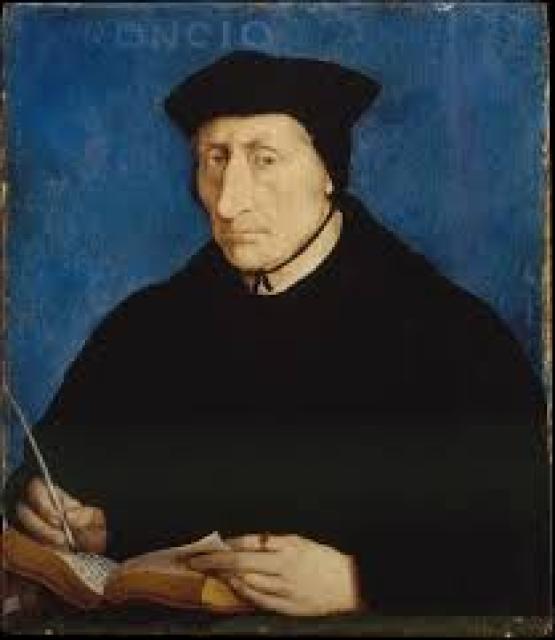
Guillaume Budy
 France
- Guillaume Budé: Renaissance Scholar and Humanist
- Founding the Collège de France and the National Library
- Translation and Scholarship
- Political and Literary Works
- "De Transitu Hellenismi ad Christianismum"
- Religious Concerns and Personal Life
Guillaume Budé: Renaissance Scholar and Humanist
Guillaume Budé, a prominent French philologist and classical scholar of the Renaissance, left an indelible mark on the intellectual landscape of his era.
Founding the Collège de France and the National Library
Budé's influential contributions included the establishment of the Collège de France, a prestigious institution of higher learning in Paris, and the foundation of a library in Fontainebleau that later evolved into the renowned Bibliothèque Nationale de France.
Translation and Scholarship
Budé's mastery of Greek led him to translate several works by Plutarch. His "Annotations on the Pandects," published in 1508, earned him recognition for his exceptional scholarship. His groundbreaking treatise "On the As," which delved into the numismatics and economics of ancient Rome, further cemented his reputation across Europe.
Political and Literary Works
Budé's intellectual pursuits extended beyond philology. His tract "On the Instruction of the Prince," published posthumously in 1547, explored political theory. He also authored "Commentary on the Greek Language" (1529), "On Philology," and "On the Correct and Timely Study of Literature" (both 1532).
"De Transitu Hellenismi ad Christianismum"
Budé's magnum opus, "On the Transition from Hellenism to Christianity" (1535), showcased his encyclopedic knowledge and imaginative symbolism. Inspired by the ideas of Erasmus, he argued for the continuity between pagan and Christian thought.
Religious Concerns and Personal Life
Budé expressed concern over the religious divisions sparked by the Reformation, as evident in his correspondence with other intellectuals. He married Roberte Le Lièvre, with whom he had eleven children. Upon Budé's death, his widow became a Calvinist, while their sons embraced the Reformation movement in France.




