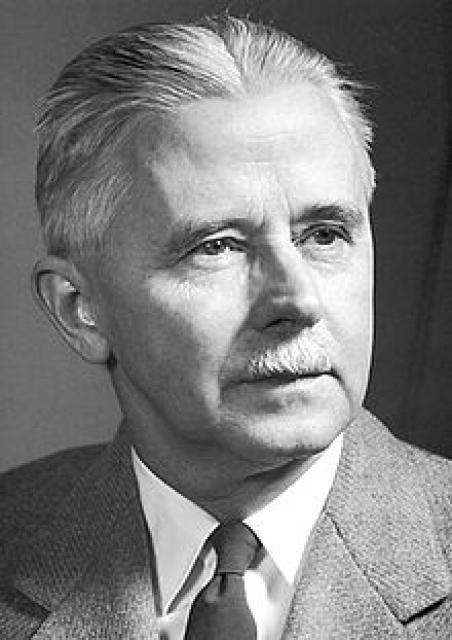
Haldan Keffer Hartline
 USA
USA- Biography of Holden Keffer Hartline
- Early Life and Education
- Research and Contributions
- Personal Life and Legacy
Biography of Holden Keffer Hartline
Holden Keffer Hartline was an American physiologist and neuroscientist who was awarded the Nobel Prize in Physiology or Medicine in 1967. He shared this prestigious honor with Ragnar Granit and Haldan Keffer Hartline for their groundbreaking research on the fundamental physiological and chemical processes in vision.
Early Life and Education
Holden Keffer Hartline was born on December 22, 1903, in Bloomsburg, Pennsylvania. His father, a biology professor at a local high school, instilled in him a passion for the natural sciences from an early age. Hartline attended Lafayette College in Easton, Pennsylvania, where he began studying visual perception in isopods, a type of terrestrial crustacean. During the summer breaks, he conducted research at the Marine Biological Laboratory in Woods Hole, Massachusetts, where he had the opportunity to work alongside renowned neurophysiologists.
After earning his Bachelor of Science degree in 1923 from Lafayette College, Hartline enrolled in the Johns Hopkins University School of Medicine. There, he continued his study of vision, mastering the techniques for investigating the electrical properties of the nervous system. In 1927, he obtained his medical degree. The year before, Edgar D. Adrian had made the first recording of electrical impulses from individual nerve cells. In 1927, Adrian also recorded the electrical impulse of the optic nerve, which was actually a bundle of hundreds of individual nerve fibers from a skate. When studying Adrian's work, Hartline aimed to expand the research by using a unified analysis of both receptors and neurons in the visual analyzer.
To establish a solid foundation for further scientific work in biophysics, Hartline spent two years studying physics at the Johns Hopkins University School. He received a scholarship from the National Research Council. He also received the Eldridge Reeves Johnson Scholarship, which allowed him to study for a semester at Leipzig University under Werner Heisenberg and two semesters at the University of Munich.
Upon returning to the United States in the spring of 1931, Hartline obtained a position at the Johnson Institute for Medical Physics at the University of Pennsylvania in Philadelphia. There, he began studying the electrical impulses of individual visual elements. According to him, his research was greatly aided by the "fortunate choice of experimental animal" – the horseshoe crab. The visual analyzer of this crab consists of bundles of receptor cells located in complex facet eyes, which are connected to the brain by long visual nerves. These nerves can be further divided into thin bundles, which then easily fragment into individual fibers that maintain their activity. Hartline and his colleague C. H. Graham were the first to record the activity of single fibers of the optic nerve in 1923. Similar to Adrian's studies on other sensory and motor nerves, Hartline also discovered that the information registered by visual receptors is transmitted as a code, which represents a set of homogeneous signals, each reflecting the intensity of the light's impact on the generating visual receptor. The intensity of the receptor's response depends on the degree of its illumination. As Hartline later stated, the "fundamental mechanism of the receptor is of a recording nature."
Research and Contributions
In 1938, Hartline shifted his focus to studying the more complex visual analyzer of vertebrates. By carefully and cautiously isolating individual fibers from frog optic nerves, he recorded their electrical activity. He wrote, "The results were unexpected. Different fibers of the optic nerves responded to light differently." Unlike the fibers of the horseshoe crab's optic nerve, which exhibited strictly identical reactions, some frog optic nerve fibers responded only to decreases in light intensity, others to increases, and still others to the presence or absence of light. At the Johnson Institute, Hartline met Ragnar Granit, who had developed a method for recording the activity of individual retinal cells. Granit was particularly interested in the role of inhibition. Hartline's research showed that individual ganglion cells of the retina, located several layers above the visual receptors and sending fibers into the optic nerve, responded better to specific combinations of receptor excitation and inhibition from which they received signals. Hartline concluded, "It is apparent that the overwhelming majority of the most complex processes occur in the thin layer of nervous tissue that forms the retina."
In 1940-1941, Hartline worked as an adjunct professor of physiology at the Cornell University Medical College in New York before returning to the Johnson Institute, where he continued his research for the next eight years. When the United States entered World War II, Hartline was assigned to study night vision in humans. He became the head of the biophysics department at the Johns Hopkins University in 1949. Hartline's experiments demonstrated that visual information is processed in the retina before reaching the brain. However, his findings offered several key approaches to understanding this mechanism. In the early 1950s, he further improved the electrical methods for recording the responses of individual visual receptors to light. In these studies, he did not use the frog's visual analyzer but returned to the horseshoe crab because, as he later explained, its retinal interconnections are sufficiently complex and therefore of interest but also simple enough for study.
Hartline discovered that the response of an individual receptor cell to light depends largely on the degree of illumination of neighboring receptors. If these neighboring receptors are brightly illuminated, the excitation of the studied receptor is inhibited. Therefore, diffuse illumination usually produces a weak visual response, whereas the response to linear and angular illumination is stronger. All the neural interactions observed by Hartline in the retina were inhibitory. His research confirmed that the "emerging effect" of inhibition, which Charles S. Sherrington had demonstrated to be crucial in controlling the functions of motor nerves, also plays a major role in shaping visual responses. Hartline noted that the network effect of visual inhibition represents contrast enhancement, in which "the marked intensity gradients in the image on the retina – edges and contours – are strengthened." David H. Hubel and Torsten Wiesel later demonstrated that visual information processed at the highest levels of the vertebrate nervous system, including the brain, employs the same image-enhancing processes that Hartline discovered in the visual analyzer of the horseshoe crab. Most of the electrophysiological studies of the horseshoe crab's retina were conducted in collaboration with Floyd Ratliff at Rockefeller University, where Hartline served as a professor from 1963 until his retirement in 1974. Hartline shared the 1967 Nobel Prize in Physiology or Medicine with Granit and Wald for their "discoveries concerning the primary physiological and chemical visual processes." When presenting the award, Carl Gustaf Bernhard of the Karolinska Institute stated that Hartline's publications "gave us a first insight into the impulse coding in visual receptors and the opportunity to acquaint ourselves with the general principles of information handling in neuronal networks that underlie sensory functions." Bernhard emphasized that "for the understanding of vision, these principles are vital for grasping the mechanisms of brightness, form, and motion perception."
Personal Life and Legacy
In 1936, Hartline married Elizabeth Kraus, a professor of comparative psychology at Bryn Mawr College. They had three sons, who later became biologists. Hartline's work was always characterized by clarity of purpose. An outdoor enthusiast, he enjoyed hiking in the mountains and flying in a sports plane. In later years, he enjoyed sailing in the bay near his summer home in Maine or in the Baltic Sea with Ragnar Granit. Hartline passed away on March 17, 1983, from a heart attack.
Hartline received numerous awards and honors throughout his career, including the Howard Crosby Warren Medal from the American Society of Experimental Psychologists (1948) and the Albert A. Michelson Medal from the Technological Institute (1964). He received honorary degrees from Lafayette College, the University of Pennsylvania, Rockefeller University, the University of Freiburg, and Johns Hopkins University. He was a member of the National Academy of Sciences, the American Association for the Advancement of Science, the American Physiological Society, the American Philosophical Society, and the American Academy of Arts and Sciences.