Harald III
 Norway
Biography of Harald III
Harald III, also known as Harald Hardrada, was the King of Norway from 1046 to 1066. He met his death in battle while attempting to conquer the English throne. Harald was born to Sigurd Syr, the King of Eastern Norway, and Asta. He was the younger half-brother of King Olaf II of Norway. Harald's father played an active role in crowning Olaf as king. From a young age, Harald showed a warrior spirit. In 1030, at the age of 15, he participated in the Battle of Stiklestad and was wounded, leading him to leave Norway.
Harald formed a military force consisting of those who, like him, were forced to leave the country following Olaf II's death. In 1031, he and his force reached Rus' and entered the service of Yaroslav the Wise. From 1031 to 1034, Harald, along with Eiliv Runolvsson, the son of Aldaygjuborg Jarl Reginald of Ladoga, took part in Yaroslav's campaign against the Poles and according to Scandinavian sagas, co-led the army.
In 1034, Harald and his retinue of around 500 men joined the service of the Byzantine Emperor as part of the elite Varangian Guard. He quickly proved himself in battle and earned the respect of the guardsmen. From 1034 to 1036, Harald participated in campaigns against pirates in Asia Minor and Syria.
From 1036 to 1040, Harald's force was part of the Byzantine army under George Maniakes during the Sicilian campaign. In 1041, he played a role in suppressing the Bulgarian uprising led by Peter II Deljan. According to sagas and Bulgarian chronicles, Harald personally killed the Bulgarian tsar in battle and became the commander of the entire guard.
In 1042, Harald and his Varangians actively participated in a palace coup, overthrowing and blinding Emperor Michael V Kalaphates. However, due to intrigues, Harald fell out of favor and had to flee Constantinople to Kiev to avoid trial. During his time in Byzantium, Harald amassed a significant amount of gold and precious stones, some of which he sent to Yaroslav the Wise for safekeeping.
In 1043, Yaroslav sent his son, Vladimir, together with Harald, to campaign against Emperor Constantine Monomachos as punishment for the murder of a famous Rus' in Constantinople. The campaign ended with a peace treaty in 1046. In the winter of 1043/1044, Harald became Yaroslav's son-in-law by marrying Elizabeth Yaroslavna (also known as Ellisif in the sagas). They had two daughters, Maria and Ingegerd. Despite being a Christian, Harald took Toru, the daughter of Jarl Torberg Arnason, as a concubine in 1048. She gave birth to his future kings Magnus II and Olaf III the Peaceful. Using the wealth accumulated during his service in the Byzantine Empire, Harald returned to Sweden in 1045 with his army, becoming a significant threat to King Magnus of Norway and Denmark, who was the son of Olaf II and Harald's nephew.
Harald formed an alliance with Sweyn II Estridsson, a claimant to the Danish throne. Magnus disrupted this alliance by making Harald his co-ruler in Norway in 1046. However, Magnus died within a year, allegedly declaring Sven as his successor in Denmark and Harald in Norway. Disagreeing with this division, Harald started a war against Sven for the Danish crown. The Danes suffered defeat after defeat, with Norwegian ships raiding coastal settlements almost every year. In 1050, Harald plundered and burned down Hedeby, the main trading center in Denmark. In 1062, in a major naval battle at the mouth of the River Nisan, Harald defeated Sven's fleet, narrowly escaping death. Despite his victories, Harald was unable to conquer Denmark, as the local nobility and common people consistently supported Sven. In 1064, Harald abandoned his claims to the Danish throne and made peace with Sven.
In addition to the lengthy and bloody war with Denmark, Harald waged war against Sweden from 1063 to 1065. The Swedish king supported rebellious jarls against Harald. In the Battle of Värne in 1063, Harald defeated the combined forces of the Swedes and rebellious Uplanders. Harald ruthlessly suppressed any attempts of disobedience within Norway, whether from ordinary peasants or powerful jarls, who were brought under royal authority. Dissenters were either killed or exiled from the country. In his efforts to establish centralized royal authority, Harald relied on the support of the Church. Under his rule, Christianity became firmly established throughout Norway. In addition to leading wars, Harald focused on strengthening trade. He founded the trading settlement of Oslo in 1048, which later became the capital of Norway.
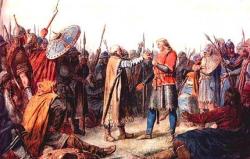
Harald met his death on September 25, 1066, in the Battle of Stamford Bridge near the city of York, against the forces of King Harold Godwinson of England. He arrived in England with a claim to the English throne, based on an alleged agreement between Magnus and Harthacnut that if either of them died without an heir, the other would inherit both England and Norway. Harald's wife Elizabeth, son Olaf, and two daughters accompanied him on this campaign. Harald left his eldest son Magnus behind in Norway, proclaiming him as the king. Tostig Godwinson, the exiled brother of Harold II Godwinson, joined forces with Harald and promised him support. Harald landed in Northern England with approximately 15,000 warriors on 300 ships and, after uniting with Tostig's forces, defeated the first English troops they encountered in the Battle of Fulford, two miles south of York, on September 20. However, five days later, his army was completely defeated in the Battle of Stamford Bridge, and only 25 of the 300 ships that arrived in England were used to transport the survivors back to Norway. Harald himself received a fatal wound in this battle, with an arrow piercing his throat.
Less than a month later, Harold II Godwinson was defeated by William the Conqueror in the Battle of Hastings and also died in battle. Harald is credited with the authorship of many poems (vísur), including one richly alliterative vísa addressed to "Gerðr inn gǫfuga" (Elizabeth Yaroslavna), praising his military exploits and lamenting that they were not valued by her. This poem has been translated and adapted multiple times by Russian poets during the Romantic era, including N. A. Lvov, K. N. Batiushkov, and A. K. Tolstoy. Harald's wife, Elizabeth Yaroslavna, is said to have disappeared from historical records after his death.
Harald had two sons, Magnus Haraldsson (1048-1069), who became the King of Northern Norway from 1066 to 1069, and Olaf III the Quiet (1050-1093), who ruled as the King of Eastern Norway from 1066 to 1069 and then as the King of Norway from 1069 to 1093. He also had two daughters, Maria, who "died suddenly on the same day and at the same hour as her father, King Harald," and Ingegerd, who married the Danish king Olaf I Sweynsson and became the Queen of Denmark.