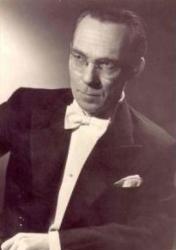
Harold Byrns
 Germany
- Early Life and Musical Training
- Early Career in Europe
- Hollywood and Musical Contributions
- Post-War Career in Europe
- Los Angeles Chamber Symphony and Schoenberg Advocacy
- Mahler and Orchestration
- Notable Orchestral Arrangements
- Recordings and Legacy
Early Life and Musical Training
Born Hans Bernstein on September 13, 1903, in Hanover, Germany, Harold Byrns followed in the footsteps of his father, a co-founder of the Hanover Chamber Music Society. He studied at the Stern Conservatory in Berlin under renowned conductors Walter Gieseking, Erich Kleiber, and Leo Blech, and served as assistant conductor to Kleiber and Blech.
Early Career in Europe
Byrns worked as a conductor in Lübeck, Oldenburg, and Berlin, at venues including the Staatsoper Berlin and the Deutsche Oper Berlin. In 1933, he emigrated to Italy and later to the United States in 1936, changing his name to Harold Byrns to avoid potential obstacles in America due to his Jewish heritage.
Hollywood and Musical Contributions
Settling in Los Angeles, Byrns founded the Harold Byrns Chamber Orchestra, which became known as the American counterpart to the Boyd Neel String Orchestra. He composed and orchestrated music for numerous films during this period. In February 1941, Byrns arranged the music for Adolphe Adam's ballet "Giselle" for Anton Dolin's production at the Ballet Theatre on Broadway.
Post-War Career in Europe
After the war, Byrns returned to Berlin and conducted at the Deutsche Oper and the Komische Oper, also guest conducting with various symphony orchestras, including the Orchestra Sinfonica RAI Di Torino. He also led concerts of Gustav Mahler's symphonies with the Wiener Symphoniker on Italian radio.
Los Angeles Chamber Symphony and Schoenberg Advocacy
In 1949, Byrns founded the Los Angeles Chamber Symphony and, a year later, conducted the premiere of George Antheil's "Serenade No. 2." Byrns was closely associated with the performance of Arnold Schoenberg's works, contributing greatly to Schoenberg's recognition as a modern composer. He conducted the Los Angeles premiere of Schoenberg's "Chamber Symphony, Op. 9," and led the Los Angeles Chamber Symphony in a concert honoring the composer's 75th birthday in 1949.
Mahler and Orchestration
Byrns orchestrated several early works by Gustav Mahler, including six songs from the cycle "Lieder und Gesänge." A close friend of the composer's widow, Alma Mahler, Byrns convinced her to allow the public performance of Mahler's Tenth Symphony. Alma considered the work a "private love letter" to her and had refused to listen to even a private recording made for her. Byrns persuaded her to hear a tape of it, leading Alma to share this masterpiece with others. Harold Byrns was awarded the Kilenyi Mahler Medal of Honor by the Bruckner Society of America for his dedication to Mahler's music.
Notable Orchestral Arrangements
Byrns excelled in orchestrating piano music and vocal and piano works. Herbert von Karajan commissioned him to orchestrate several piano pieces by Robert Schumann, and Dietrich Fischer-Dieskau asked him to orchestrate some of Mahler's songs, which Byrns also translated into English. Byrns made possible the full orchestration of Nicolas Nabokov's opera "Love's Labour's Lost," which premiered in Brussels in 1973. For Otto Klemperer's Copenhagen debut in 1947, he arranged a suite from Henry Purcell's "The Fairy Queen."
Recordings and Legacy
With his Los Angeles orchestra, Byrns made numerous recordings, including the premieres of Béla Bartók's "Music for Strings, Percussion and Celesta" and Igor Stravinsky's "Violin Concerto." Harold Byrns died on February 22, 1977, in Berlin and is buried there.