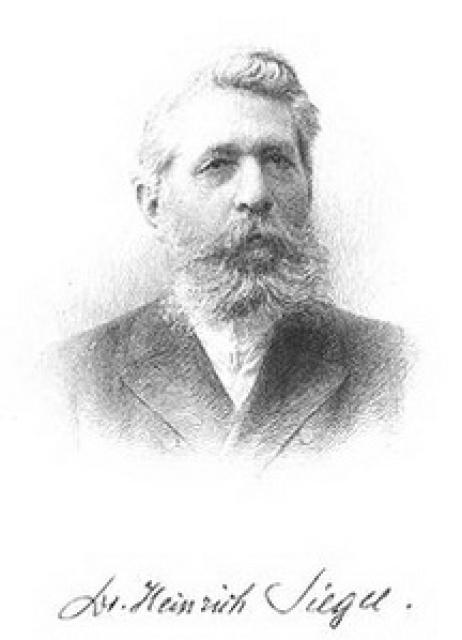
Heinrich Siegel
 Germany
Education and Early Scholarship
Heinrich Joseph Siegel was born on April 13, 1830, in Ladenburg, in the Grand Duchy of Baden. He grew up in Bruchsal, where he completed secondary school before continuing his studies in Heidelberg. He pursued law at the universities of Heidelberg, Bonn and Giessen, while also attending lectures in history, philosophy and literature.
Siegel’s early work focused on German inheritance law. A Latin essay he wrote as a student won a prize from Heidelberg’s law faculty in 1851. He developed the research into a dissertation at Giessen, where he earned his doctorate in 1852. The following year, a study of German kinship and inheritance law qualified him to teach German law. After several years as a private lecturer, he was appointed to the University of Vienna in 1858.
Building a School of Legal History
At Vienna, Siegel taught German legal history, German private law and the history of criminal law. He became a full professor in 1862 and established a seminar called the Germanistische Gesellschaft in 1871. His students included future scholars Arnold Luschin von Ebengreuth and Ernst von Schwind.
Siegel’s research drew on medieval legal sources to explain how law developed in German-speaking lands. He studied inheritance, marital property, court procedure and Austrian provincial law, among other subjects. His work Das Versprechen als Verpflichtungsgrund im heutigen Recht (The Promise as a Basis of Obligation in Modern Law, 1873) explored the legal force of a promise in German law, setting it against the Roman legal tradition.
His contributions were both analytical and institutional. Siegel helped organize the publication of medieval Austrian legal sources, and in 1870 he and Karl Tomaschek edited the first volume of Die Salzburgischen Taidinge. His textbook Deutsche Rechtsgeschichte, published in 1886, brought together many of his findings. He is regarded as a founder of the Vienna school of Austrian legal historians.
Academic Leadership and Legacy
Siegel held major academic responsibilities at the University of Vienna, serving as dean in 1867–68 and 1873–74 and as rector in 1878–79. He was also a member and later a senior officer of the Imperial Academy of Sciences in Vienna, and belonged to scholarly societies in Austria, Germany and Britain. The university honored him with a bust in its arcaded courtyard, unveiled in 1902.
He retired in 1898 for health reasons and died in Vienna on June 4, 1899. Siegel’s lasting influence came from pairing close legal analysis with historical research: he treated medieval statutes, court records and customary law as evidence for how legal institutions worked and changed. His teaching and scholarship helped make Vienna a leading center for the study of German and Austrian legal history.


