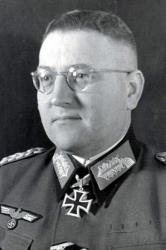
Heints Guderian
 Germany
Heinz Guderian
Heinz Wilhelm Guderian (1888-1954) was a German general and tank commander who distinguished himself in the early stages of World War II. However, he was quickly withdrawn from the front by Hitler after the first setback, when he was forced to retreat from Moscow. Guderian, along with de Gaulle and Fuller, was considered a pioneer of mechanized warfare.
Early Life and Military Career
Heinz Guderian was born on June 17, 1888, in Kulm (now Helme, Poland). He graduated from the military academy in 1907 and the military academy in 1914. During World War I, he held staff positions and after the war, he served in the Reichswehr. In 1922, he joined the motorized troops and from 1935 to 1938, he commanded a tank division and an army corps.
Role in World War II
During the Anschluss, Guderian commanded the newly formed 16th Corps, which made a rapid advance towards Vienna, although a significant portion of the tanks became stuck along the way. In 1939, Guderian's tank units participated in the invasion of Poland, successfully implementing the blitzkrieg tactics, which earned him Hitler's admiration.
Guderian believed in the decisive role of tanks in modern warfare, and he outlined his theories in his books "Achtung - Panzer!" and "Panzer Warfare and its Interaction with Other Branches of the Armed Forces" (1937). In early 1940, he commanded a tank corps in France, and from June 1940, he led the 2nd Panzer Group (later renamed the 2nd Panzer Army). However, in December 1941, he was relieved of his command after the defeat near Moscow and placed in reserve. From March 1943, he served as the Inspector General of the Armored Forces.
Later Life and Legacy
During the July Plot of 1944, Guderian was unsuccessfully approached multiple times to join the conspirators. After the failed assassination attempt on Hitler, Guderian, along with Keitel and Rundstedt, investigated the cases of army officers implicated in the plot. Those found guilty were stripped of their military rank and handed over to the People's Court, resulting in their certain death. In July 1944, Guderian was appointed Chief of the General Staff of the Ground Forces, a position he held until March 1945.
Towards the end of the war, Guderian made several timid attempts to convince Ribbentrop, Göring, and Himmler to stop fighting against the Allies, but Hitler ignored such recommendations. Guderian was taken prisoner by the Americans but was soon released. In the 1950s, he advocated for the restoration of Germany's pre-war borders and military strength as a bulwark against communism. Heinz Guderian passed away on May 15, 1954, in Schwangau, Bavaria.
Heinz Guderian is remembered as one of the most influential tank commanders and military theorists of his time. His theories and tactics had a profound impact on the development of armored warfare and continue to be studied and applied in modern military doctrine. His memoirs, titled "Panzer Leader," were published in 1957 and provide valuable insights into his experiences during World War II.