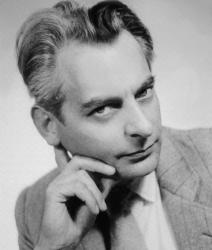
Hermann Scherchen
 Germany
- Early Life and Musical Beginnings
- Conducting Career in Europe
- Notable Works and Recordings
- The Scherchen Technique
- Personal Life and Legacy
Early Life and Musical Beginnings
Herman Scherchen was born on June 21, 1891, in Berlin. At a young age, he studied viola and performed as a violist in the Bluthner Orchestra in Berlin.
Conducting Career in Europe
From 1914 to 1916, Scherchen served as conductor in Riga. He then held positions in Konigsberg from 1928 to 1933. Opposed to the Nazi regime, he left Germany and settled in Switzerland.
In Winterthur, Scherchen became a leading figure in shaping the city's musical life. From 1922 to 1950, he was the principal conductor of the Winterthur Municipal Orchestra, now known as the Orchester Musikkollegium Winterthur. He championed the works of contemporary composers, including Arnold Schoenberg, Richard Strauss, and Edgard Varèse.
Notable Works and Recordings
One of Scherchen's most celebrated achievements was his orchestration and recording of Johann Sebastian Bach's "The Art of Fugue." His 1958 recording of Beethoven's "Eroica" Symphony on Westminster Records set a benchmark in the interpretation of the third symphony.
The Scherchen Technique
Like Vasily Safonov and Leopold Stokowski, Scherchen often conducted without a baton. His technique, which involved minimal hand gestures, could create challenges for musicians. According to BBC Symphony Orchestra bassoonist Ian Wallace, interpreting Scherchen's movements was like "trying to milk a flying mosquito."
Personal Life and Legacy
Scherchen was married five times, fathering numerous children. His youngest daughter, Tona Scherchen, became a renowned composer. After his death in Florence on June 12, 1966, Scherchen left behind a substantial discography and a lasting legacy as a pioneer in the world of conducting.