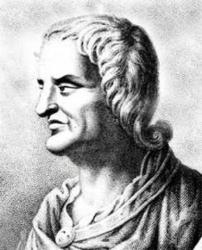
Ibycus
 Greece
Biography of Ibycus
Ibycus, a Greek lyric poet, was born in the Greek colony of Rhegium in southern Italy. Little is known about his life, but he is considered the senior contemporary of Anacreon and was included in the canonical list of the Nine Lyric Poets by the scholars of Hellenistic Alexandria.
It is said that Ibycus was offered a position by the tyrant of Rhegium, but he left the city due to political unrest. He lived as a wanderer and eventually joined Anacreon, who was at the court of the tyrant Polycrates of Samos. According to an inscription on a tomb, Ibycus died in his hometown. However, there is a legend that he was killed on his way to the Isthmian Games in Corinth. He was attacked by a gang of robbers and fatally wounded. As he lay dying, Ibycus looked up at the sky and saw a flock of cranes. "Be my avengers!" he exclaimed. The robbers laughed and went into the city to watch the games, from which Ibycus never returned. While sitting in the theater, one of the robbers saw the flying cranes and jokingly said to his companion, "Here come Ibycus's avengers." This remark was overheard, and the audience became agitated. The speaker was apprehended, questioned, and the robbers admitted to their crime. The phrase "Ibycus's cranes" became a proverb among the Greeks, referring to a crime revealed through divine intervention.
Works and Influence
Alexandrian scholars of the 2nd and 3rd centuries BCE collected Ibycus's works into seven books. Fragments of his texts have been discovered in Egypt (El-Bahnasa, ancient Oxyrhynchus), which are believed to have been part of this collection. The surviving fragments consist of 40 lines and include examples of monodic and choral lyrics (the latter being the earliest known examples of choral lyric poetry in general).
Early in his poetry, influenced by Stesichorus, Ibycus often narrated stories from mythology, although he would modify the original legends, toning down the heroic elements. Upon arriving in Samos, Ibycus turned to a lighter form of love poetry, which ultimately brought him fame in antiquity. The main theme of his work during this period was love for beautiful boys and girls. It is believed that these songs were performed by choirs of boys at beauty contests, such as those held on the island of Lesbos.
The poem dedicated to Polycrates (or his son) in the Oxyrhynchus papyrus is the earliest known epinikion—a choral poem composed for a private individual to celebrate a victory in games. It can be considered that Ibycus was the creator of the epinikion genre in response to the social demand from the court circle of Polycrates of Samos. Ibycus served as a link between western and eastern Greek poetry: he wrote in the Doric dialect and used meters that originated in the Doric school, but his tone and content were very close to the Aeolian (Ionian) school.