Igor Stravinsky
 France, Russian Empire, United States, Switzerland
- A breakthrough with the Ballets Russes
- Exile, reinvention, and new forms
- A late turn toward serial music
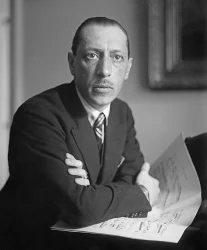
Igor Stravinsky’s career reads like a map of twentieth-century music in motion: from Russian folklore and startling ballet rhythms to classical forms recast for a modern age, and finally to the daring language of serial composition. His music could be theatrical, witty, austere, or explosive, but it was always built with a composer’s instinct for shape and color.
Born in Oranienbaum, near St Petersburg, on June 17, 1882, Stravinsky grew up in a household where music was part of daily life. His father, Fyodor, was a celebrated bass at the Mariinsky Theatre. Igor first studied law, but his ambitions turned decisively toward composition after he met Nikolai Rimsky-Korsakov, who became his mentor and guided his early musical education.
A breakthrough with the Ballets Russes
The young composer’s fortunes changed through his association with impresario Sergei Diaghilev. Diaghilev commissioned The Firebird, whose 1910 Paris premiere made Stravinsky an overnight sensation. The score’s shimmering orchestration and vivid Russian fairy-tale world showed how confidently he could command a large orchestra. Petrushka followed in 1911, giving a tragic puppet story a sharp, modern musical voice.
Then came The Rite of Spring. Its 1913 premiere in Paris, staged with choreography by Vaslav Nijinsky, became one of classical music’s most famous theatrical flashpoints. The ballet imagined pagan rituals and a sacrificial dance, while its pounding rhythms, dense harmonies, and sharply accented patterns challenged familiar expectations of how orchestral music should move. The audience reaction was famously tumultuous; the score’s reputation, however, only grew. Stravinsky had helped open a new path for modern music.
Exile, reinvention, and new forms
The First World War and the Russian Revolution made life between Russia and Western Europe increasingly difficult. Stravinsky settled in Switzerland during the war years, then moved to France in 1920. Rather than repeat the style of his early ballets, he kept changing direction. Pulcinella turned to older musical models with a modern edge, helping launch a long neoclassical period. Works such as the Octet, Oedipus Rex, and Symphony of Psalms drew on earlier forms and traditions while retaining his distinctive precision and energy.
Stravinsky was also a performer and a vivid public figure, conducting his own works and appearing as a pianist. His partnerships with Diaghilev and choreographers helped make the ballet a central laboratory for musical experiment. In 1939, after a series of personal losses and with war spreading in Europe, he moved to the United States. He became an American citizen in 1945 and made his home in California, while continuing to travel and conduct internationally.
A late turn toward serial music
In the 1950s, Stravinsky began exploring serial techniques associated with composers such as Arnold Schoenberg and Anton Webern. He absorbed these methods on his own terms, producing works including Agon and Threni that sound neither like his Russian ballets nor his neoclassical scores. This late shift showed a restless artist still listening closely to the musical world around him.
Stravinsky died in New York on April 6, 1971, aged 88. He was buried on the cemetery island of San Michele in Venice, near Diaghilev. Across a career of more than six decades, he repeatedly changed the sound of his music—and helped change what audiences thought music could do.