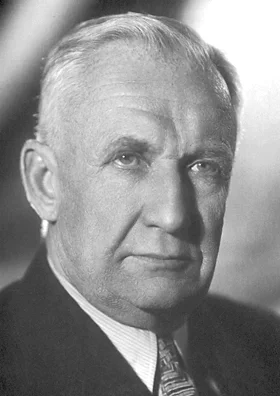
Igor Tamm
Igor Yevgenyevich Tamm was a leading Soviet theoretical physicist whose work ranged from quantum mechanics and nuclear theory to the behavior of radiation in matter. He shared the 1958 Nobel Prize in Physics for helping explain Cherenkov radiation, the blue light produced when charged particles move through a material faster than light travels in that material. His career also included a major role in Soviet thermonuclear research and the mentorship of Andrei Sakharov.
From Vladivostok to Moscow
Tamm was born on 8 July 1895 in Vladivostok, in the Russian Empire. His father was an engineer, and the family later lived in Ukraine. After finishing school, Tamm spent a year studying at the University of Edinburgh. He returned to Russia at the outbreak of the First World War and enrolled in physics and mathematics at Moscow University, graduating in 1918.
The revolutionary years were unsettled. Tamm became involved in the Menshevik movement and took part in political activity during 1917. During the Civil War he taught physics at universities in Crimea and Odessa, navigating the upheaval as the country’s political order changed. He later returned to Moscow, where he began teaching and developing a research program that brought him into contact with leading physicists in Europe and the Soviet Union.
A theorist of radiation and matter
Tamm became one of the central figures in Soviet theoretical physics. In 1934, physicist Pavel Cherenkov observed a distinctive glow when certain liquids were exposed to radiation. Tamm and Ilya Frank developed the theory that explained it: charged particles emit light when they pass through a medium faster than light can travel through that medium. The effect became known as Cherenkov radiation and proved useful in particle detectors and studies of cosmic rays.
The Nobel Prize in Physics was awarded jointly to Cherenkov, Frank, and Tamm in 1958 for the discovery and interpretation of the effect. Cherenkov’s experiments revealed the phenomenon; Tamm and Frank supplied its theoretical explanation. The radiation’s characteristic blue glow is also familiar today from images of water surrounding operating nuclear reactors.
Tamm’s work extended well beyond this celebrated result. He studied quantum theory, nuclear forces, cosmic rays, and the magnetic properties of elementary particles. From 1934 until his death, he led the theoretical division at the Lebedev Physical Institute in Moscow, where he trained a generation of physicists. Sakharov, who later became internationally known for both nuclear work and human-rights activism, regarded Tamm as a formative mentor.
Nuclear research and later legacy
In 1948, Tamm was asked to lead a theoretical group examining the feasibility of a thermonuclear weapon. Sakharov joined the team, and the group contributed to the Soviet hydrogen-bomb program. Tamm’s scientific career therefore encompassed both fundamental research and work on weapons with enormous destructive power. In 1950, he and Sakharov also proposed a magnetic-confinement design for controlled fusion that became part of the line of research associated with the tokamak.
Tamm remained active at the Lebedev Institute and in Soviet scientific life for the rest of his career. He died in Moscow on 12 April 1971. His legacy reflects the breadth of twentieth-century physics: a Nobel-recognized explanation of a striking optical effect, influential work across theoretical physics, and a central role in training scientists who shaped both peaceful research and the nuclear age.