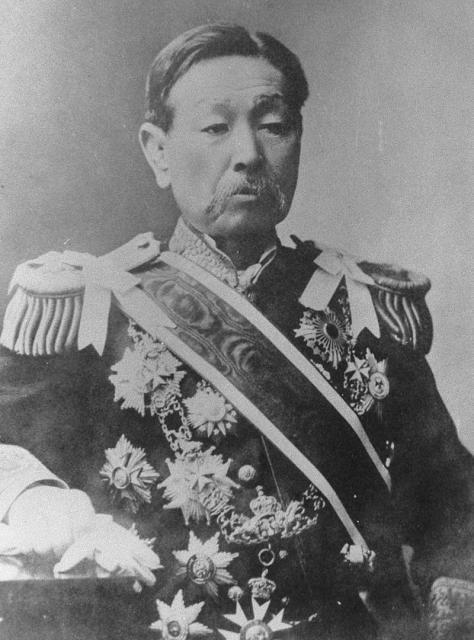
Inoue Kaoru
 Japan
Japan- Early Life and Education
- Political Activism and Westernization
- Restoration and Government Service
- Progress and Partnerships
- Ministries and Diplomacy
- Cabinet Positions and Foreign Affairs
- Influence and Legacy
Early Life and Education
Inoue Kaoru was born on January 16, 1836, into a samurai family in the Choshu Domain. His father was a page to the domain's lord. As a child, Kaoru was adopted into the Shishido family, where he changed his name to Tamon. However, he later returned to his own Inoue clan.
Political Activism and Westernization
In the early 1860s, Kaoru became involved in the radical movement "Sonno Joi" (Revere the Emperor, Expel the Barbarians). In 1862, he participated in an attack on the British legation in Shinagawa, alongside Takasugi Shinsaku. However, he subsequently traveled to Britain in 1863 for a period of study. This experience transformed Kaoru's views, convincing him of the importance of centralization and Westernization for Japan.
Restoration and Government Service
After the start of the Shimonoseki War in 1864, Kaoru returned to Japan. He played a key role in convincing the Choshu Domain to abandon its isolationist policy and concentrate on overthrowing the Tokugawa shogunate. He facilitated an alliance between Satsuma and Choshu for this purpose.
After the Meiji Restoration in 1868, Kaoru joined the new Imperial government, serving as an Imperial Councillor and head of the Foreign Bureau. In 1869, he became the head of the Trade Department, and in 1871, he was appointed Vice Minister of Finance.
Progress and Partnerships
During the Iwakura Embassy's travels abroad, Kaoru withdrew from politics briefly and established a trading firm that would later become Mitsui Bussan, part of the Mitsui Group. In 1875, he returned to government as a member of the Senate. That same year, he served as Vice-Ambassador Extraordinary to Korea to resolve the aftermath of the Ganghwa Island Incident.
Ministries and Diplomacy
Kaoru resumed his post as Imperial Councillor in 1878 and became Minister of Industry. The following year, he was appointed Minister of Foreign Affairs. In 1884, he visited Korea again as an ambassador after the Kapsin Coup. He also played a significant role in establishing a national postal system and railway while promoting Japanese industry and agriculture.
Cabinet Positions and Foreign Affairs
With the introduction of the premiership and cabinet system in 1885, Kaoru remained a prominent figure in government. He held the positions of Minister of Foreign Affairs (1885-1887), Minister of Agriculture and Commerce (1888-1889), Minister of the Interior and Deputy Prime Minister (1892-1894), and Minister of Finance (1898).
As Foreign Minister, Kaoru pursued the revision of the unequal treaties that Japan had signed with the United States and European powers in 1858. He promoted Japan's Westernization to enable the country to negotiate with foreign nations on equal terms.
Influence and Legacy
Kaoru had close ties with influential financial and business leaders. In 1883, he founded the Kyoraikai (Joy Society) for consultations with them. His relationship with the Mitsui corporation was particularly strong. In 1900, the company hired him as a lifelong advisor, allowing him to continue influencing the corporation's development and the nation's economy.
In 1884, Kaoru was elevated to the ranks of titled nobility and received the title of count. In 1907, he was promoted to marquis. In 1904, he was awarded the honorary title of genro, giving him significant authority in politics.
Kaoru Inoue died on September 1, 1915, at his villa in Okitsu (now Shizuoka), Shizuoka Prefecture.





