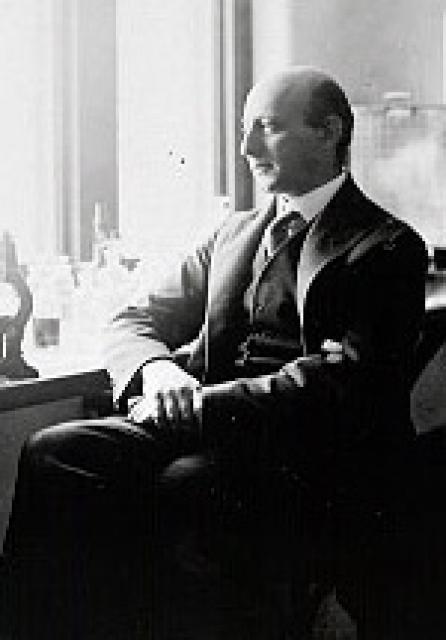
Richard Goldshmidt
 USA
USA- Biography of Richard Goldschmidt
- Early Life and Education
- World War I and Exile
- Research and Contributions
- Legacy
Biography of Richard Goldschmidt
Richard Goldschmidt was an American geneticist and evolutionary biologist of German descent. He was one of the first scientists to combine the achievements of genetics and embryology in the development of evolutionary ideas. Goldschmidt introduced important concepts such as norm of reaction, genetic assimilation, and dynamic genetics. He proposed a model of macroevolution through macromutations, which is widely known as the "hopeful monsters" hypothesis.
Early Life and Education
Richard Goldschmidt was born in Frankfurt-am-Main, Germany, into a Jewish family. He began studying zoology and medicine at Heidelberg University in 1899. In 1903, he obtained a doctoral degree in philosophy. In 1909, Goldschmidt became a professor at the University of Munich, but he left this position in 1914 to lead the genetics section at the newly founded Kaiser Wilhelm Institute of Biology.
World War I and Exile
The outbreak of World War I caught Goldschmidt in Japan, which prevented him from returning to Germany. He was forced to go to the United States, where he ended up in a camp for "undesirable Germans." In 1919, Goldschmidt returned to Germany, but in 1935, under pressure from the Nazi regime, he was once again forced to leave and continue his work at the University of California, Berkeley.
Research and Contributions
While studying sex genetics in the silk moth, Goldschmidt remained a staunch Darwinist for two decades. However, his research led him to conclude that intraspecific variability does not lead to the formation of new taxa, and natural selection can only eliminate unsuccessful mutants. Around 1932, he developed a new understanding of the mechanisms of speciation. He identified these mechanisms as systemic mutations, which he called macromutations. In 1940, his widely recognized book "The Material Basis of Evolution" was published in New Haven. The book primarily focused on the genetic causes of macroevolution and was largely directed against Darwinism.
Legacy
Richard Goldschmidt's contributions to the fields of genetics and evolutionary biology were significant. His integration of genetics and embryology paved the way for further advancements in evolutionary theory. Although some of his ideas diverged from the mainstream at the time, his work continues to be influential and has contributed to the ongoing discussions on the mechanisms of evolution.




