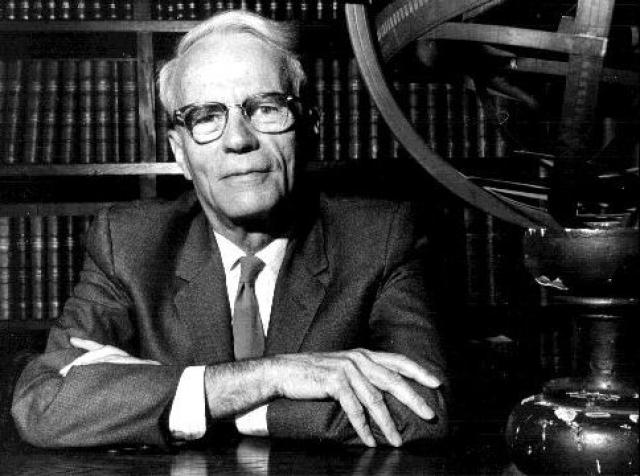
Ira Sprague Bowen
 USA
USABiography of Ira Sprague Bowen
Ira Sprague Bowen, an American physicist and astronomer, was born on December 21, 1898, in Seneca Falls, New York. He was the son of Philinda Sprague and James Bowen. Due to frequent moves, Ira received homeschooling until his father's passing in 1908. In the same year, he started attending Houghton College, a Christian evangelical liberal arts college, where his mother worked as a teacher. After completing high school in 1915, Bowen pursued a two-year course at Houghton College and then enrolled in Oberlin College, graduating in 1919. During his time at Oberlin, Ira conducted research on the properties of steel alongside scientist Robert Hadfield, with their findings published in 1921.
In 1919, Bowen began studying physics at the University of Chicago. By 1921, he joined the research group of Robert Andrews Millikan. Influenced by George Ellery Hale, Bowen followed Millikan to the California Institute of Technology. This connection led Bowen to work at the Mount Wilson Observatory and Mount Palomar Observatory.
Contributions and Discoveries
Bowen lectured on general physics at the California Institute of Technology, conducted research on cosmic rays, and maintained an interest in ultraviolet spectroscopy. He studied the ultraviolet spectra of neon, nitrogen, and oxygen in various stages of ionization. Drawing inspiration from a chapter on gaseous nebulae and low-density radiation emission in the book "Astronomy" by Henry Norris Russell, Raymond Smith Dugan, and John Quincy Stewart, Bowen made his most significant discovery.
In 1927, he explained the mysterious emission lines, particularly in the green part of the spectrum, observed in the spectra of gaseous nebulae. Sir William Huggins, who discovered the "forbidden" spectral lines in 1868, proposed the existence of a previously unknown chemical element and named it "nebulium." However, Bowen determined that ordinary oxygen and hydrogen, under cosmic conditions not found on Earth, could exhibit such "forbidden" spectral lines, such as those with wavelengths of 4959 and 5007 angstroms. He published his findings, concluding that nebulium was not a chemical element.
Accomplishments and Legacy
Ira Bowen became a member of the National Academy of Sciences in 1936. Prior to his retirement, he contributed to improving the optical designs of several significant optical instruments, including the 100-inch "Irenee duPont" telescope at the Las Campanas Observatory. Even after retiring in 1964, Bowen continued to provide assistance.
Bowen is also well-known in the field of meteorological science. The ratio of sensible heat fluxes from the Earth's surface to latent heat fluxes is known as the Bowen ratio. Ira Sprague Bowen passed away on February 6, 1973. In his honor, a small impact crater on the visible side of the Moon and asteroid 3363 Bowen were named after him.
Bowen received several prestigious awards, including the Gold Medal of the Royal Astronomical Society, the Henry Draper Medal, the Catherine Wolfe Bruce Gold Medal, and the Frederic Ives Medal, among others.


