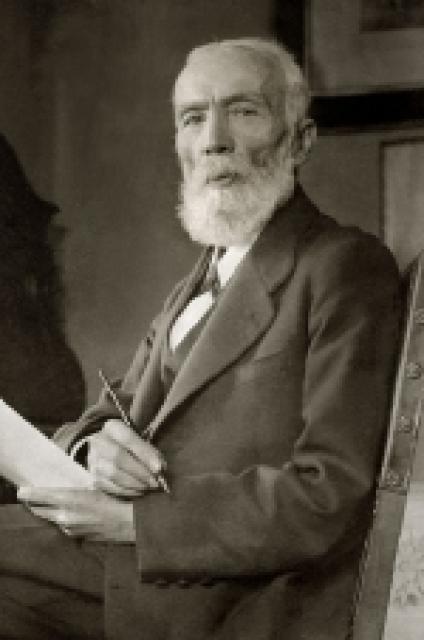
Ivan Puluy
 Ukraine
Biography of Ivan Puluj
Ivan Puluj was an outstanding Ukrainian physicist and electrical engineer, a science organizer, and a public figure. He was born in 1845 into a deeply religious Greek Catholic family. In 1865, he graduated from Ternopil Gymnasium and enrolled in the Theological Faculty of the University of Vienna, which he completed with distinction. Later, he joined the Physics and Mathematics Department of the Faculty of Philosophy at the same university, where he studied until 1872. He became an associate professor at the University of Vienna.
In 1874-1875, Ivan Pavlovich taught physics at the Naval Academy in Fiume (now Rijeka, Croatia). In 1875, as a scholarship holder of the Austrian Ministry of Education, Ivan Puluj furthered his professional knowledge under the guidance of Professor August Kundt at the University of Strasbourg. In 1876, he obtained a scientific degree of candidate of sciences. In 1884, the Ministry of Education of the Austro-Hungarian Empire offered Ivan Pavlovich to head the Department of Physics at the German Technical High School (now the Czech Technical University) in Prague, where he transformed it into the first physics and electrical engineering department in Europe in 1903. From 1888 to 1889, Ivan Pavlovich was the rector of this school and he led the department he created for 32 years. Moreover, Ivan Puluj served as a state advisor on electrical engineering for Czechia and Moravia. In 1916, he was offered the position of Minister of Education of Austria, but he declined due to his health condition. He died in 1918 in Prague, where he was buried.
Contributions to Science
Ivan Puluj became interested in phenomena generated by electric current in a vacuum during his time at the University of Strasbourg. He mastered the craft of glassblowing and produced glass tubes for his experiments and the needs of his physicist colleagues. His friend Nikola Tesla, who was also interning with Professor A. Kundt at that time, learned the art of tube production from Puluj. Together, Ivan Puluj and Nikola Tesla conducted a series of research on gas-discharge tubes and, according to many historians of science and physicists, they came closest to unraveling the nature of the radiation generated by cathode rays.
Upon returning from Strasbourg to Vienna, Ivan Puluj continued to study phenomena in tubes. In 1880-1882, he described visible cathode rays in detail. In 1881, he constructed a tube emitting X-rays, which served as a precursor to modern X-ray machines. This tube, known as the "Puluj lamp," was awarded the Silver Medal at the International Electrical Exhibition in Paris. It became famous worldwide and was even produced in series for some time. Invented 14 years before Wilhelm Conrad Roentgen's discovery, this device generated rays that were later named X-rays following the suggestion of anatomist Collier. With the help of this device, Ivan Puluj made the first X-ray images in the world, including a picture of a 13-year-old boy's broken arm, his daughter's hand with a pin beneath it, and the skeleton of a stillborn child. Puluj's series of X-ray images of human organs were so clear that they allowed for detecting pathological changes in patients' bodies. However, the lack of a properly equipped laboratory and financial difficulties greatly hindered the scientist's research.
Contributions to Ukrainian Culture
Ivan Puluj is also known for his contributions to the promotion of Ukrainian culture. While studying at Ternopil Gymnasium, he founded the youth circle "Hromada" for the study and popularization of Ukrainian history and culture. During his student years, he became the organizer of the "Vienna Sich," which united Ukrainian youth in the Austrian capital. Together with Panteleimon Kulish and Ivan Nechuy-Levitsky, Ivan Puluj made the first translation of the New and Old Testaments into Ukrainian, published in 1903 by the British and Foreign Bible Society. He actively supported the establishment of a Ukrainian university in Lviv and published articles in support of the Ukrainian language. As a professor, Ivan Puluj organized scholarships for Ukrainian students in Austria-Hungary. He was a full member of the Shevchenko Scientific Society.