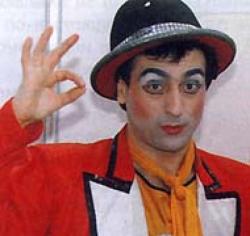
Jango Edwards
 USA
USA- Jango Edwards: American Clown and Showman
- The Clown's Mission
- European Influences
- International Recognition
- The Power of Laughter
- The Clown's Role
- The Art of Observation
- Physical Expression and Live Performances
- The Nouveau Clown Institute
- Moscow Performance
- The Essence of Clowning
Jango Edwards: American Clown and Showman
"A Clown Lives Inside Us All"Stanley Ted Edwards, known as Jango Edwards, was born on April 15, 1950, in Detroit, Michigan. From a young age, he immersed himself in radical politics, philosophy, religion, and esotericism. After reading P.B. Ouspensky's "The Fourth Way" and traveling extensively throughout Europe, Edwards embarked on a lifelong journey as a clown.

The Clown's Mission
Edwards sees the clown as a vessel for liberation, a way to "help the clown within us all become free." He combines traditional clowning with political and countercultural allusions, aiming to provide a mirror for society and inspire change.

European Influences
Edwards spent much of his career performing in Europe, particularly in France, Spain, the Netherlands, and England. His one-man shows drew heavily from the traditions of European cabaret, blending physical comedy with insightful commentary.

International Recognition
Beginning in 1975, Edwards became a key organizer and performer at the International Fool's Festival in Amsterdam, a renowned platform for alternative comedy and clowning. He gained a loyal following in the Netherlands and has performed extensively throughout Europe, especially in Germany.

The Power of Laughter
Edwards believes that laughter is a powerful tool for relaxation and self-awareness. "When you laugh, you use the body's natural ability to let go," he explains. "Laughter is a means of breaking tension, a way for the nervous system to release the stresses of the day."
The Clown's Role
"To be a clown is to understand an art form built on giving," Edwards asserts. "It is to use both the body and the heart, drawing from the subtle worlds as well as the grotesque." He sees clowns as disruptors of social norms, mirror-carriers, and agents of change.
The Art of Observation
According to Edwards, being a clown requires continuous observation and learning. "The external 'I' should become a paradigm of the absurd, while the internal one is a temple of reason," he explains. "The clown is a mirror in which we see ourselves, a mirror that helps us observe what is happening in our world."
Physical Expression and Live Performances
Edwards' work often incorporates physical comedy and audience interaction. He released a DVD of live performances in 2004 titled "Jango Edwards: The Best of Jango." He has also released four audio albums featuring recordings of his live performances.
The Nouveau Clown Institute
In 2009, Edwards established the Nouveau Clown Institute in Granollers, Barcelona, a training center for clowns worldwide. The institute is self-financed and continues to operate without government or private funding.
Moscow Performance
Edwards performed in Moscow, Russia, in 2018, showcasing his interactive and unscripted show, "The Laboratory of Joy." The program featured clowns, stilt walkers, and mimes from various countries.
The Essence of Clowning
Edwards emphasizes the importance of self-development and dedication in the pursuit of professional clowning. "To be a professional clown requires years of study, self-improvement, and tomfoolery," he says. "It's a difficult task, and few can do it well." He believes that true clowns focus on global change and personal growth, rather than commercial success.