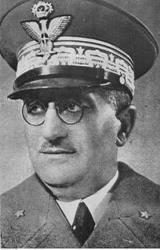
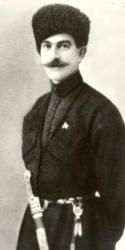
Jean-Baptiste Broussier
 France
Biography of Jean-Baptiste Broussier:
Jean-Baptiste Broussier was a French soldier and general who lived from 1766 to 1814. He was born into a relatively poor but devoutly religious family. Broussier's father had hoped that he would become a clergyman and spread the Word of God to the masses. He even enrolled him in a prestigious seminary in the city of Toul. However, studying Catholic dogmas quickly bored Jean-Baptiste, and he was filled with patriotic feelings and a thirst for adventure. In 1791, he volunteered to join the 3rd battalion of the Merte department. That same year, on September 6th, he was appointed captain of this unit, which was sent to the Central and then the Moselle Army under General Bernonville.
On December 14, 1792, Broussier sustained his first injury in battle near Wavre. On February 15, 1794, he was transferred to the 34th demi-brigade, which was fighting as part of the Sambre-Meuse Army. On February 20, 1796, he was attached to the 43rd infantry demi-brigade (Kolos division). Later that same year, he was temporarily incapacitated due to a severe head injury. In 1797, he distinguished himself in the Italian Army during the capture of the city of Spezia. He was one of the first to breach the fortifications of Forte Chiusa and personally captured an Austrian general at Tarvisio. For his actions, he was temporarily appointed colonel of the 43rd demi-brigade (confirmed in this rank on March 29, 1797). From October 24, 1798, while serving with General Duhamel's division, Jean-Baptiste participated in the siege of Civita del Tronto (December 7) and the capture of Pescara. In 1799, Broussier fought in the Neapolitan Army, where he distinguished himself at Benevento (January 18, 1799), defeated Cardinal Ruffo's army, and suppressed the Calabrian uprising in Apulia, capturing and destroying the main strongholds of Andria and Trani.
For his military successes in the Neapolitan theater of operations, with the assistance of General Championnet, Broussier was promoted to brigadier general on February 3, 1799 (according to some sources, February 15, 1799). However, on March 19, he was falsely accused, along with General Championnet, of bribery, removed from his post, and stripped of his rank, which was only restored to him after the coup of June 30, 1799. On November 25, 1799, Broussier was appointed commander of Valenciennes. On March 29, 1800, he was temporarily transferred to the reserves and then sent back to Italy as part of General Loison's division. On May 25, he took position at Fort Bar, on June 5, he blockaded Pizzighettone, on June 12, he crossed the Adda River, and the next day he captured Cremona. After this rapid march, Broussier went to the military camp in Amiens, and on October 12, 1800, he returned to Italy once again. From 1801 to 1803, he served as the governor of Milan. On September 22, 1803, he was appointed military commander of Paris. He lost this honorary position on November 7, 1805, becoming the chief of staff of the Northern Army. On February 7, 1806, he was transferred as the commander of the reserve division to Marshal Lefebvre's corps.
On June 16, 1806, Broussier arrived at the location of the Italian army as a replacement for General Sebastiani, who had left on a diplomatic mission to Turkey. From March 1809, he commanded the 2nd division under General Bogarne. He participated in the war against Austria, suffering a defeat at Diageno on April 11, 1809. In the battle of Sacile on April 16, he commanded the left flank and later the rearguard of the viceroy's army. From April 28, the general was attached to Marshal MacDonald's corps, leading the 1st infantry division. With his division, he fought fiercely at the Piave River on May 8, Villa Nova on May 11, Prevaldi on May 16, and Tarvisio on May 18. On May 21, he captured Laibach and then besieged Graz. During the Battle of Wagram on July 5-6, 1809, his division acted at the forefront of MacDonald's famous column, whose goal was to break through the Austrian ranks. For this battle, Broussier was awarded the Order of the Legion of Honor, and in October of the same year, he was elevated to the rank of count. In 1810, he commanded the 2nd military district of the Italian Kingdom (Brescia). From April 20, 1811, he was in charge of the 2nd division of the observation corps in Italy, which became the 4th corps of the Grande Armée on April 1, 1812.
Broussier participated in the Russian campaign as the commander of the 14th infantry division, which distinguished itself in the battles of Ostrovno, Borodino (storming the Kurgan heights), the Battle of Maloyaroslavets (supporting the depleted and commander-less 13th infantry division), and finally, at Krasny (covering the Emperor's retreat and the 4th corps). By November 17, 1812, the glorious 14th division had only 400 men left. On June 24, 1813, Broussier took command of the 3rd division of the Mainz Observation Corps. On November 2, Napoleon personally entrusted him with the defense of Strasbourg and Kehl against the advancing allies. He carried out this order until the abdication of the emperor. The Bourbon rulers appointed him to an administrative position in his native department of Meuse on June 21, 1814.
On December 13, 1814, Jean-Baptiste Broussier passed away at the age of 48, succumbing to a stroke that put an end to his illustrious career.