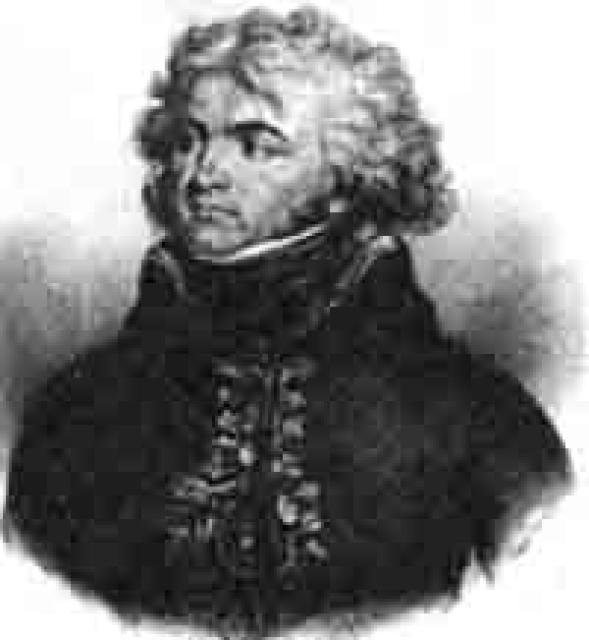
Jean Kleber
 France
Biography of Jean-Baptiste Kléber
Jean-Baptiste Kléber, a divisional general, was born on March 9, 1753 in Strasbourg, France. He was the son of an architect and initially pursued a career in architecture, working in Besançon and Strasbourg. However, he later decided to join the military and attended a military school in Munich.
In April 1777, Kléber joined the Württemberg regiment under General Kaunitz and served as an aide-de-camp to Prince Kaunitz during the War of the Bavarian Succession. He was promoted to sub-lieutenant on April 1, 1779 and transferred to the Imperial Guard in the same year. However, in 1785, he left the Austrian service and returned to Alsace, where he worked as a building inspector.
In July 1789, Kléber joined the National Guard as a grenadier. On January 8, 1792, he became an aide-de-camp in the 4th Upper Rhine Battalion and was promoted to lieutenant colonel of the 2nd Upper Rhine Battalion on May 20, 1792. He participated in the defense of Mainz and was promoted to brigadier general on August 17, 1793 for his distinguished service. After the surrender of Mainz, he was sent to Vendée with General Custine to fight against the royalists. On September 19, 1793, he suffered a defeat against the forces of Charette.
From November 5, 1793, Kléber commanded the 1st division in Vendée. In early 1794, he received a division in the Northern Army and distinguished himself in the Battle of Fleurus on June 26, 1794, where he commanded the left flank. He held high positions in the revolutionary army and even promoted Jean-Bernadotte to brigadier general on the battlefield. However, he had several short-lived appointments as commander of the Sambre-Meuse and Rhine armies in 1795.
In 1796, Kléber commanded the left wing of General Jourdan's army and achieved victory at Altenkirchen and Friedberg. On October 12, 1796, he was appointed commander of the 1st army, but he resigned from the position just five days later. Known for his height, stature, and commanding presence, Kléber enjoyed great authority among his subordinates.
On January 12, 1798, Kléber was appointed commander of the guard units in the Army of England. In May 1798, he was sent to Egypt as part of the Eastern Army. He captured Alexandria and on July 5, 1798, became the commander of the province. From October 22, he commanded in Cairo and on January 17, 1799, he replaced General Dugua as the commander of a division. He organized an expedition to Syria, capturing El Arish, Gaza, Jaffa, and Saint-Jean d'Acre.
After Napoleon's departure from Egypt on August 21, 1799, Kléber assumed command of the remaining Eastern Army. He strongly opposed the continuation of the expedition and engaged in negotiations with the enemy. On January 24, 1800, he signed a convention with the British and Turkish forces in El Arish, agreeing to evacuate Egypt in exchange for safe passage of his troops to France. However, the British refused to ratify the convention and resumed military operations.
On March 20, Kléber achieved a decisive victory over a 70,000-strong Turkish army with his 12,000 troops near Heliopolis. His successful actions forced the British government to reconsider the convention favorably, but he was assassinated by an Islamic fanatic named Suleiman. A monument was erected in his honor in Strasbourg.