
Jean Piaget
 Switzerland
Biography of Jean Piaget
Jean Piaget was a Swiss psychologist and philosopher known for his groundbreaking work on cognitive development in children. He was born in Neuchâtel, Switzerland in 1896, to Swiss father Arthur Piaget and his wife Rebecca Jackson. Even as a child, Jean showed a keen interest in biology and zoology, publishing several articles on mollusks by the age of 15 and gaining recognition among his biologist colleagues.
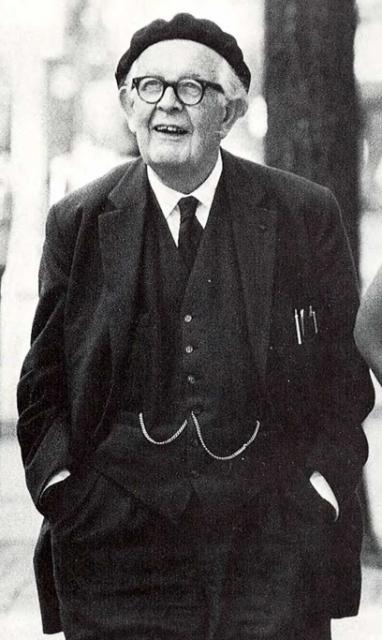
He pursued his education at the University of Neuchâtel and the University of Zurich, where he published two philosophical articles that showcased his thinking at the time, although he later regarded them as immature. It was during this period that Jean became interested in psychoanalysis. He later moved to Paris, where he taught at Alfred Binet's school and assisted in the development of Binet's renowned intelligence tests. It was during this time that Jean noticed children persistently giving incorrect answers to certain questions, which intrigued him. He concluded that these errors occurred because cognitive processes in young children differ significantly from those in older children and adults. This led him to develop a comprehensive theory of cognitive development stages.

In 1921, Piaget returned to Switzerland and became the director of the Rousseau Institute in Geneva, under the leadership of Édouard Claparède, whose ideas he was familiar with. From 1925 to 1929, Piaget held a professorship in psychology, sociology, and scientific philosophy at the University of Neuchâtel. In 1929, he was offered the position of director at the International Bureau of Education, a role he held until 1968.

According to Harry Beilin, Piaget's theoretical work can be divided into four phases: a sociological model of development, a biological model of intellectual development, the development of a logical model of intellectual development, and research on figurative thinking. In the first phase, Piaget focused on exploring the hidden aspects of children's thinking. He argued that as children mature, they transition from natural egocentrism to sociocentrism. Through specially designed question sets, Piaget demonstrated that children gradually shift from intuitive answers to "scientific" and, more importantly, socially accepted answers. Piaget proposed that this transition occurs through the socialization of children under the influence of older and more authoritative peers.

In the second phase of his research, Piaget believed that the process of thinking and intellectual development could be understood from a biological-evolutionary perspective. He introduced the concepts of assimilation and accommodation as the two primary processes by which children learn about the world around them.
Piaget's third model posited that the development of intelligence involves a series of sequential and obligatory stages. These stages are arranged in a spiral-like pattern, where children have to reevaluate and reformulate ideas from previous stages at each new stage.
Finally, in his fourth phase of research, Piaget focused on the study of "illogical" thinking that resists formalization but plays a significant role in human life.
Jean Piaget passed away on September 16, 1980, at the age of 84. As per his wishes, his body was buried in an unmarked grave at the Cemetery of Kings in Geneva, alongside his loved ones.


